Maple’s fundamentals are driving outperformance
Maple is outperforming peers on growth, yield, and revenue — while benefiting from limited supply overhang and clear value accrual

Anna.zabella/Shutterstock and Adobe modified by Blockworks
This is a segment from the 0xResearch newsletter. To read full editions, subscribe.
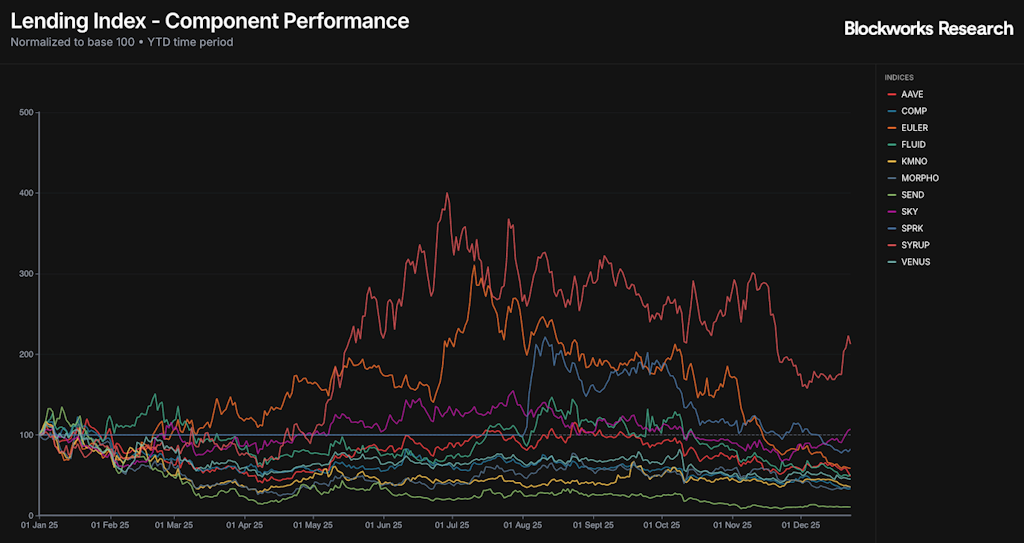
Maple (SYRUP) is up 26% over the past week, outperforming all other money markets in our lending index. Alongside Sky, it is the only asset in the index with a positive year-to-date performance, and by a broad margin, up 112% vs. Sky’s 7%. What’s driving Maple’s strength, and how has it remained resilient despite challenging market conditions?
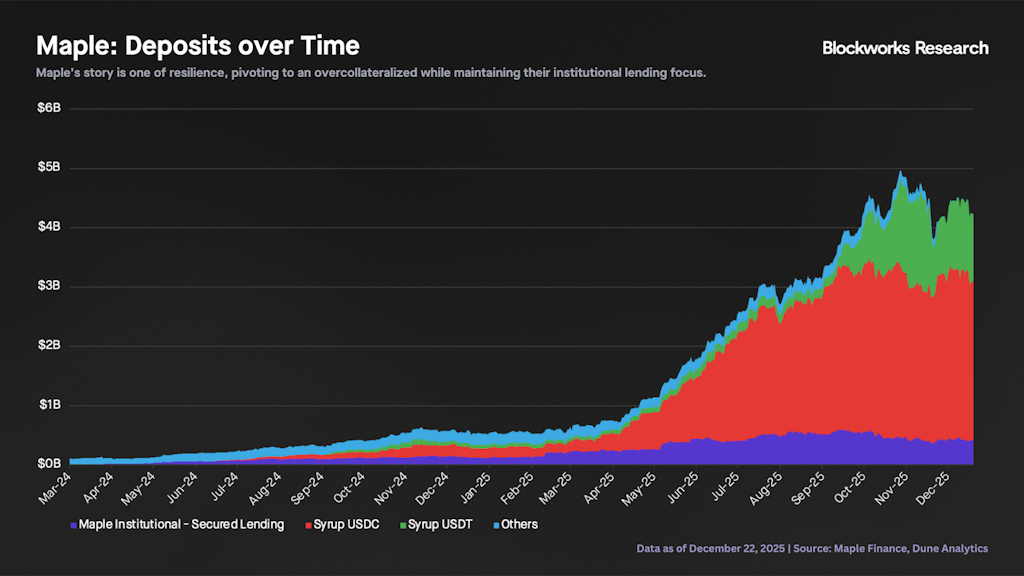
Maple, as one of DeFi’s longest-standing lending protocols, was able to come back from the 2022 credit crisis by pivoting away from undercollateralized lending toward a fully secured, overcollateralized model, with an institutional approach: Permissionless Syrup pools accept USDC or USDT deposits (syrupUSDC, syrupUSDT), while permissioned pools accept only USDC. Capital from these pools is then deployed OTC to institutional borrowers, collateralized by BTC or other highly liquid cryptoassets.
As seen below, Maple has surpassed $4 billion in deposits, with about 63% of deposits coming from the syrupUSDC pool, 27% from the syrupUSDT pool, and 10% from Maple Institutional (its permissioned secured lending pool).
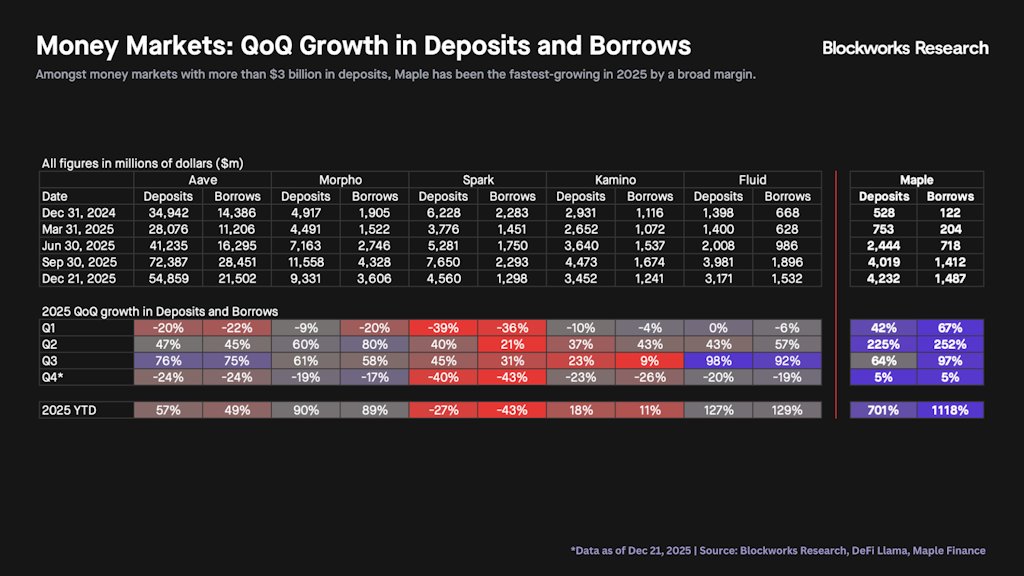
How does Maple stack up against other money markets? Among protocols with more than $3 billion in deposits, Maple has been the fastest-growing in every quarter this year except Q3, when it ranked second behind Fluid. Q2 marked Maple’s strongest quarter, with deposits up 225% and borrows rising more than 250%. Year-to-date, deposits have grown an exceptional 701%, while outstanding loans are up 1,118%. Notably, loan origination has outpaced growth in deposits, underscoring increasingly high utilization.
Maple’s growth has largely been driven by syrupUSDC, which as we mentioned accounts for 63% of Maple’s deposits ($2.66 billion) as of Dec. 21. One of the attractive selling points of syrupUSDC is the sustained high yield, linked to stable demand from Maple’s institutional client base. syrupUSDC has outperformed all other benchmark yields in the cohort year-to-date, with an average APY of ~8%. However, it’s worth noting that in recent months the yield has been declining, with Morpho’s USDC yield remaining competitive since August and outperforming sharply during November.
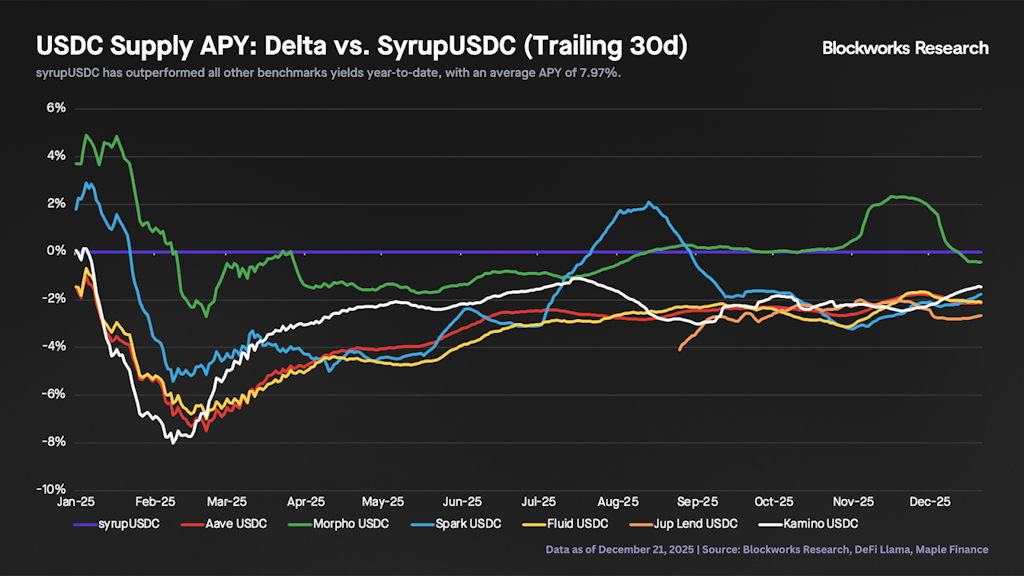
Regarding the methodology, we use market-weighted USDC supply rates across competing protocols, based on base interest paid by borrowers (excluding any incentives). We then compute trailing 30-day annualized rates and compare them to the benchmark yield, syrupUSDC.
Another growth catalyst for syrupUSDC and syrupUSDT has been deep DeFi integrations. Maple’s yield-bearing stablecoins have been integrated into Pendle’s PT markets and onboarded as collateral across several money markets (Aave, Fluid, Jup Lend, Spark, and Kamino), enabling looping strategies against non-yield-bearing stables. This kind of distribution can further accelerate Maple’s growth, particularly during periods when syrupUSDC outperforms benchmark yields, including Ethena’s sUSDe.
Putting it all together, Maple has outpaced competing money markets year-to-date in both deposit and borrow growth, as well as USDC supply yields. How has that performance translated into revenue? The table below compares Maple against its peers on quarterly revenue and price-to-sales multiples.
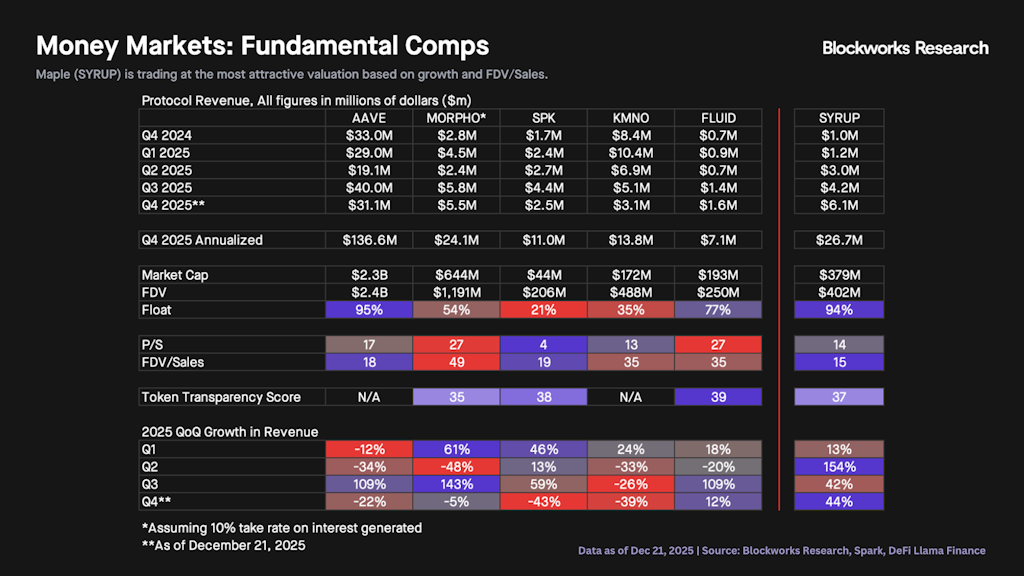
Based on Q4 2025 revenue figures, Maple (SYRUP) is trading at the most attractive valuation of the cohort on a growth and FDV/Sales basis. Maple’s annualized revenue run rate has increased 533% YoY, from $1.0 million in Q4 2024 to a forecasted $6.6 million in Q4 2025.
Regarding token distribution, all initial team, advisor, seed investor, and public sale allocations were fully vested as of 2023, eliminating supply overhang concerns. Of note, SYRUP scored 37 on the Token Transparency Framework, indicating that the project has fully disclosed its revenue streams, equity to token holder rights, advisory service providers, and executive team personnel.
Given Maple’s fundamentals, alongside a favorable token structure (limited supply overhang and clear disclosures around value accrual), it’s unsurprising that SYRUP is the best-performing lending token year-to-date and has continued to show notable relative strength in recent days.
Get the news in your inbox. Explore Blockworks newsletters:
- The Breakdown: Decoding crypto and the markets. Daily.
- 0xResearch: Alpha in your inbox. Think like an analyst.