Capital gets selective
Unit economics inflect, institutional capital shows up onchain, and market structure continues to evolve
New York Stock Exchange tradequotex, "Trading Floor at the New York Stock Exchange during the Zendesk IPO" (CC license")"
This is a segment from the 0xResearch newsletter. To read full editions, subscribe.
As dispersion continues, this week has pointed to concrete shifts rather than narrative noise. Aerodrome’s net income moved toward breakeven as emissions fell in line with revenue, while USDai’s TVL showed stepwise growth. At the same time, tokenized assets continued to scale across credit, Treasurys and commodities, while new trading infrastructure, from ultra-low latency chains (Fogo) to equity perpetuals, pushed closer to traditional market benchmarks.
Indices
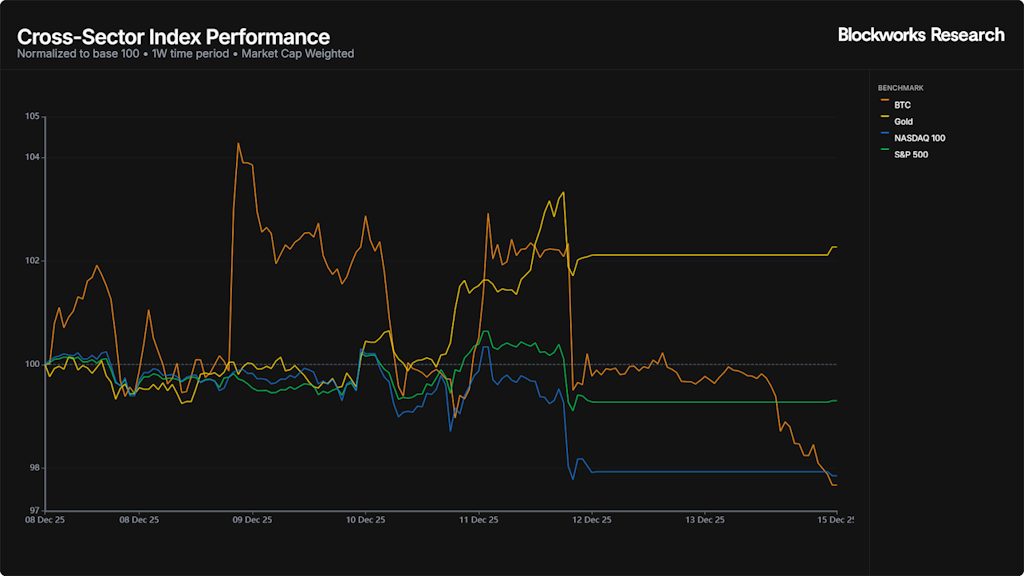
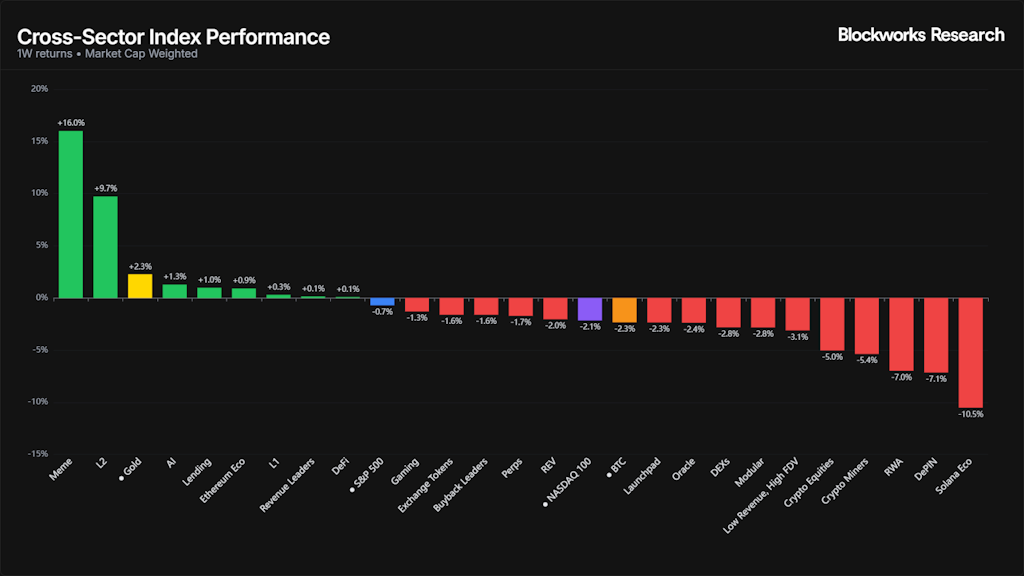
Markets leaned risk-off over the past week, with dispersion widening across both traditional and digital assets. BTC slipped (-2.3%) while the Nasdaq 100 (-2.1%) and S&P 500 (-0.7%) also closed lower, reflecting a softening risk backdrop. Gold (+2.3%) stood out as one of the few macro hedge bids, suggesting incremental rotation toward defensives as positioning reset into year-end.
Crypto sector indices told a sharper story. On the upside, Memecoins (+16.0%) and L2s (+9.7%) dominated weekly gains, pointing to short-term speculative flows and demonstrating renewed optimism around scaling narratives and higher beta players. AI (+1.3%), Lending (+1.0%), and Ethereum Ecosystem (+0.9%) also managed modest green prints. In contrast, weakness was pronounced across Solana Ecosystem (-10.5%), DePIN (-7.1%), RWAs (-7.0%), and Crypto Miners (-5.4%), underscoring pressure on structurally levered or capex-heavy themes. Launchpads (-2.3%) and DEXs (-2.8%) also lagged as volumes cooled.
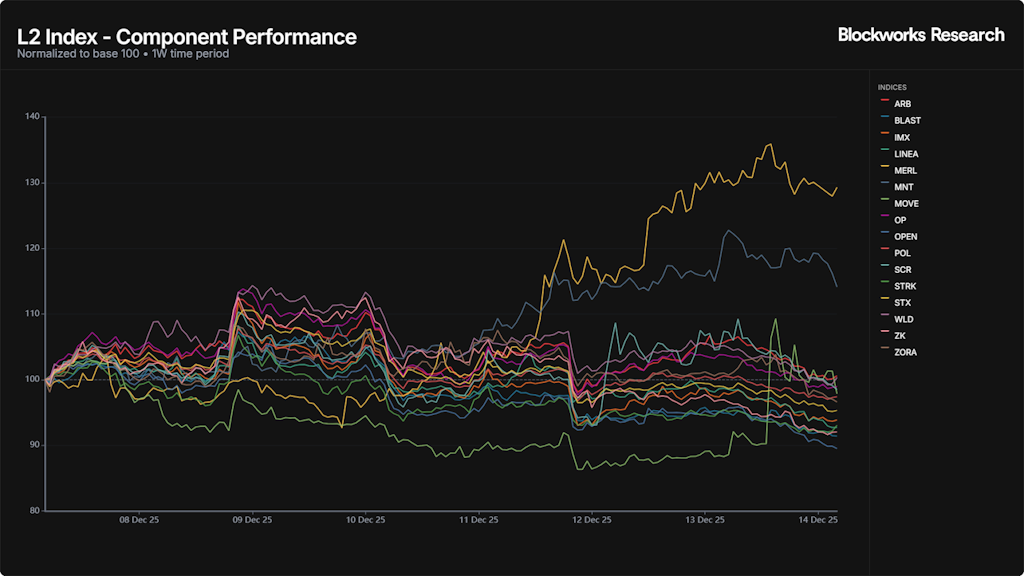
While the L2 sector outperformed this week, under the hood, dispersion was notable. MERL was the standout, ripping higher into the week’s close and finishing well north of its peers. MNT also saw strong relative strength, grinding steadily higher and holding gains even as the rest of the complex chopped sideways. OP and ARB tracked closer to the index average, posting modest gains but failing to show the same upside convexity. On the lagging end, BLAST remained the clear underperformer, trending lower throughout the week.
Charts for The Week
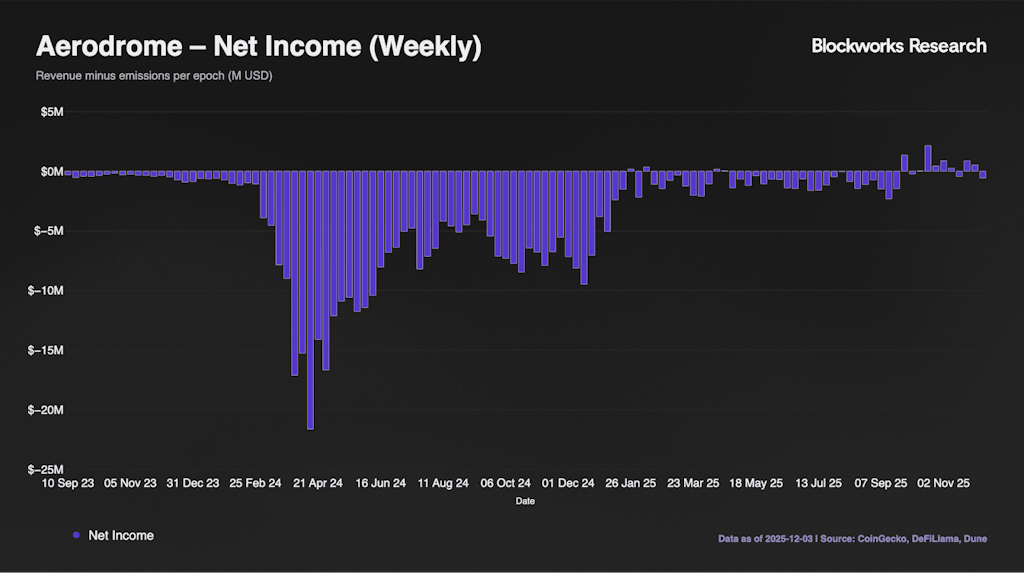
Aerodrome’s weekly net income (protocol revenue minus token emissions) is transitioning from a prolonged period of heavy losses to near breakeven and occasional profitability. Throughout most of 2024, emissions materially exceeded revenue, with weekly net losses reaching as much as ~$20 million at the trough, reflecting aggressive liquidity incentives. However, starting in early 2025, losses narrowed sharply as emissions declined and revenue stabilized, with recent weeks oscillating around zero and turning modestly positive at times. This inflection supports the view that Aerodrome’s unit economics are improving, with protocol revenue now broadly keeping pace with emissions for the first sustained period since launch.
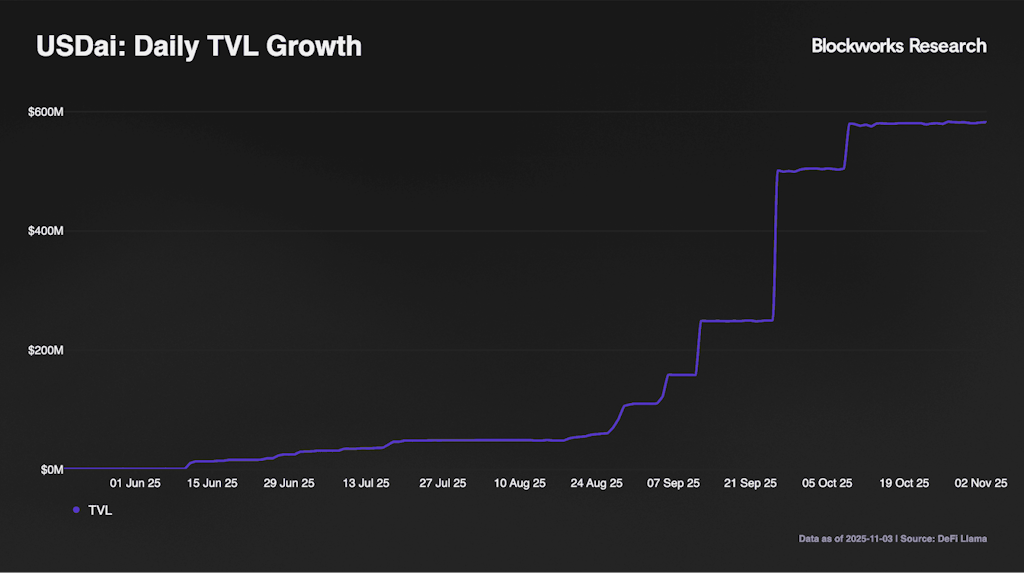
USDai’s TVL trajectory reflects a classic step-function adoption curve consistent with institutional balance sheet deployment rather than organic retail inflows. TVL accelerated sharply in September as several large capital allocations entered the system. The discrete jumps suggest tranche-based deployments tied to predefined mandates. The plateauing of TVL above ~$550 million into November implies capital stickiness and low redemption pressure, reinforcing the view that USDai is functioning as a balance sheet instrument rather than a pure trading vehicle.
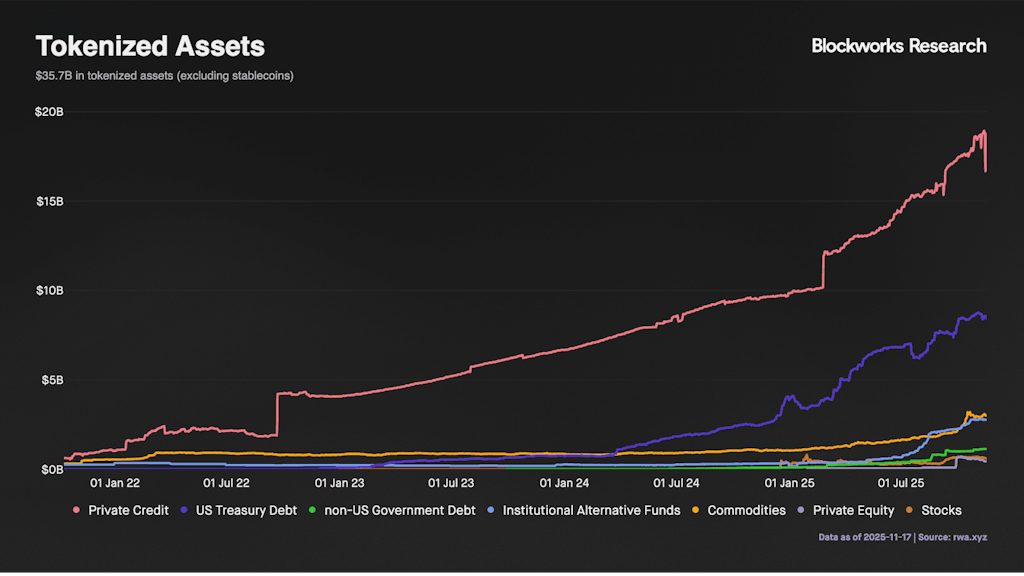
Tokenization has evolved from a niche experiment to a strategic priority for global financial institutions. Today’s tokenized asset market is composed of $300 billion in stablecoins, $17.4 billion in private credit, $8.2 billion in US government debt, $2.3 billion in commodities, and $1.4 billion in public equities. Estimates underscore the scale of this shift. A report by BCG and ADDX projects that up to $16 trillion of real-world assets could be tokenized by 2030, spanning public equities, private markets, real estate and debt instruments. Similarly, Citi forecasts $4-5 trillion in tokenized digital securities and an additional $5 trillion in tokenized trade finance volume over the same period.
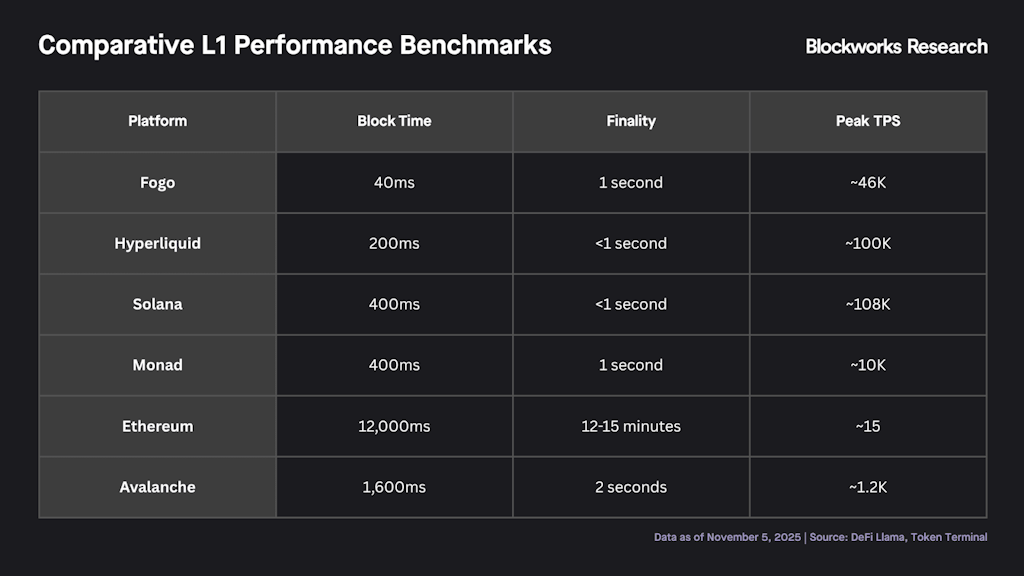
Fogo stands out with industry-leading 40ms block times and ~1-second finality, delivering materially faster execution than Solana’s 400ms blocks and far superior responsiveness compared to Ethereum’s multi-minute finality. While Hyperliquid and Solana post higher peak TPS figures on paper, Fogo’s combination of ultra-low latency and sub-second finality positions it closer to traditional financial market infrastructure, reinforcing its thesis as an institutional-grade trading chain rather than a broad consumer L1.
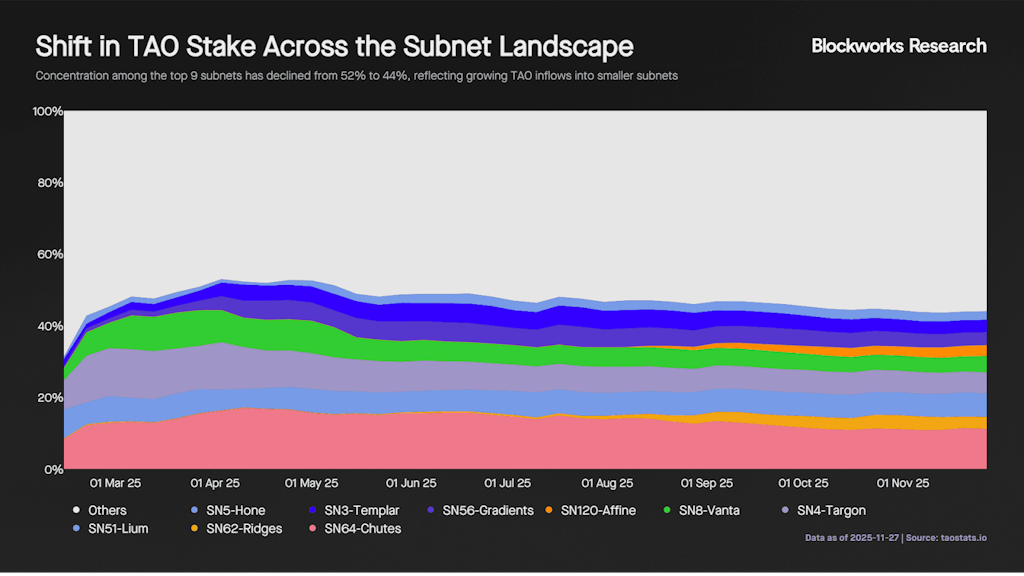
Outside of Root, the top nine subnets currently hold ~44% of all TAO staked across subnets and receive 37.4% of TAO emissions. This concentration has been steadily declining from a high of ~52% in May 2025 as more TAO flows into smaller or emerging subnets. The trend suggests a gradual broadening of participation and a healthier distribution of stake over time.
Get the news in your inbox. Explore Blockworks newsletters:
- The Breakdown: Decoding crypto and the markets. Daily.
- 0xResearch: Alpha in your inbox. Think like an analyst.