Revenue declines and ETF outflows keep pressure on the crypto market
Meanwhile, high performance in AI and DePIN signals a renewed speculative appetite in infrastructure and computation.

Media Whale Stock/Shutterstock and Adobe modified by Blockworks
This is a segment from the 0xResearch newsletter. To read full editions, subscribe.
Crypto opened the week with uneven signals. BTC gained +2.5%, but application and network revenues hit multi-month lows, and BTC ETFs saw their fourth-straight week of outflows. While AI and DePIN jumped +9%, broader activity remains soft, highlighting a market still searching for conviction.
Indices
Risk assets leaned modestly risk-on, with BTC (+2.5%) posting a steady gain while traditional equities lagged, as both the S&P 500 (-0.1%) and Nasdaq 100 (-0.1%) slipped slightly. Gold (+0.1%) was essentially flat, reflecting a muted macro backdrop. Overall tone skewed constructive, driven largely by strength across crypto-native sectors.
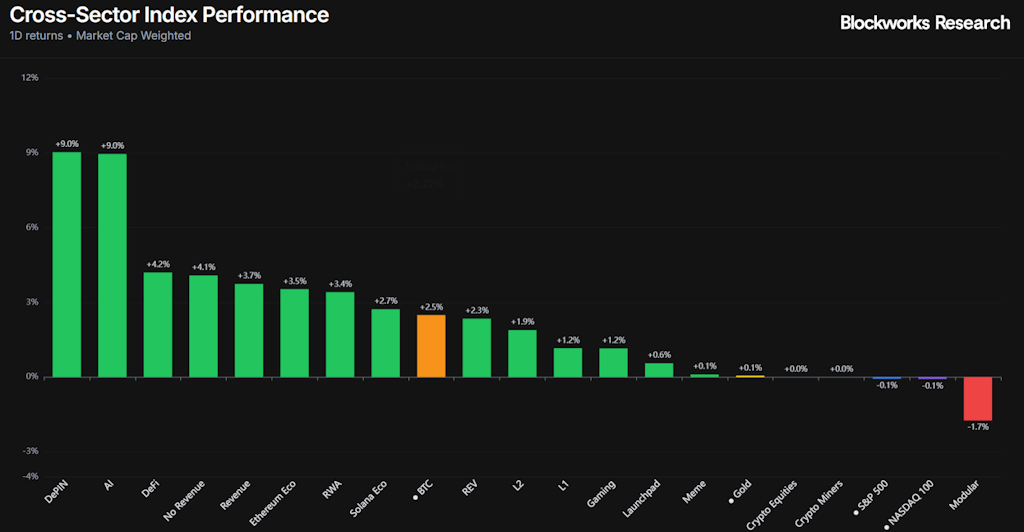
Over the last 36 hours, crypto sector breadth was notably strong. DePIN (+9.0%) and AI (+9.0%) led the board, continuing their multi-week momentum as investors rotate toward higher-beta thematic plays. DeFi (+4.2%) followed alongside solid showings from Ethereum-aligned assets (+3.5%). On the downside, Modular (-1.7%) was the only meaningful decliner, marking a sharp divergence from the otherwise broad green sweep.
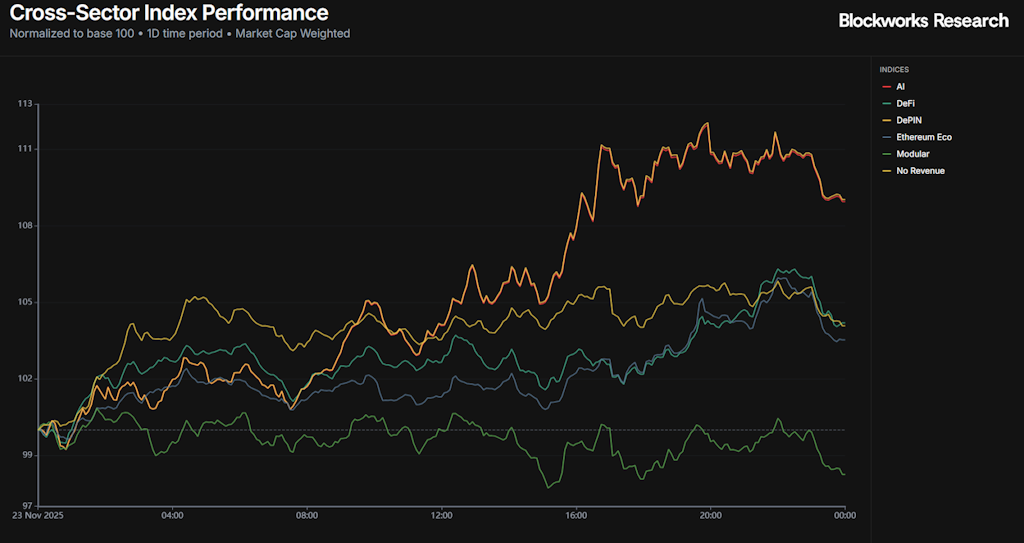
The dispersion suggests a clear preference for high-growth, high-narrative segments rather than broad-based macro buying. AI and DePIN’s outsized moves (both +9%) signal renewed speculative appetite in infrastructure and computation themes as traders position ahead of upcoming macro releases. With equities pausing and volatility suppressed, crypto remains the higher-beta expression of incremental risk-taking. Looking ahead, attention turns to this week’s macro catalysts, which could dictate whether BTC’s grind follows through or stalls. Sector rotation remains active, suggesting volatility may pick back up as positioning normalizes.
Charts for The Week
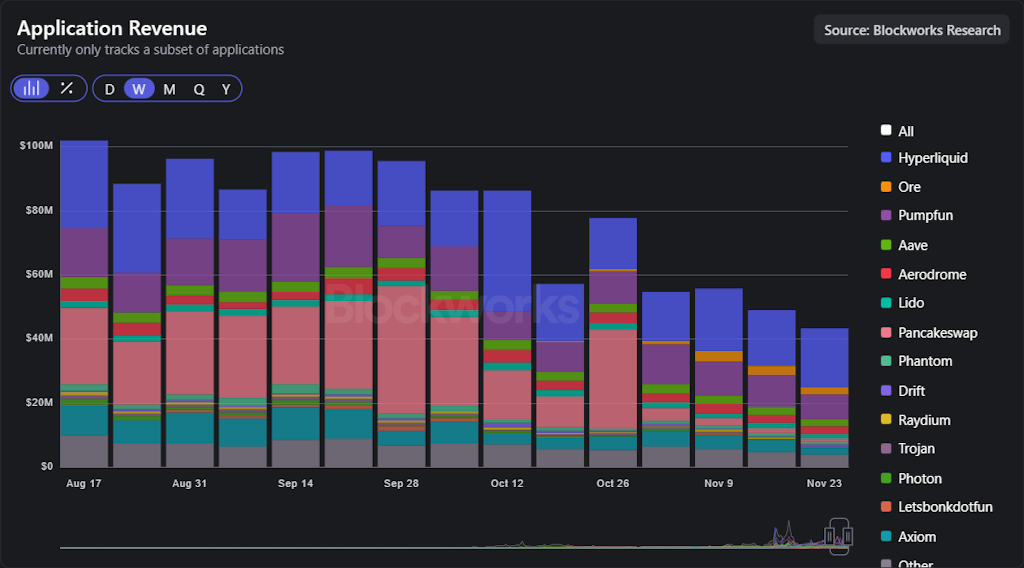
Overall, application revenue was down 11% week over week from $49 million to $43.5 million — the lowest weekly revenue since March 2025. Hyperliquid continues to lead in terms of application revenue, making $18.5 million over the past week (up 8%), followed by pump.fun, which made $7.7 million (down 22%). Ore took third place for the first time, generating $2.3 million in the last week.
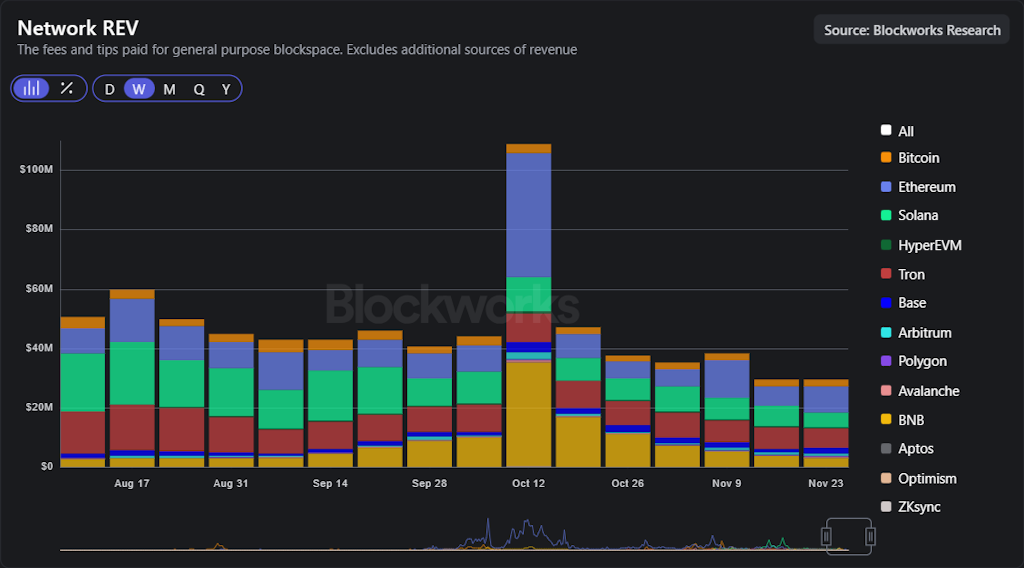
Weekly Network REV has been faring even worse, with the last two prints (both around $29.5 million) the lowest since 2022. Ethereum took top spot ($8.9 million), a position it’s been in and out of for the past few weeks. Solana remains in third with $5.1 million (down 15%) and Tron in second with $6.3 million (down 12.5%). Solana was the market leader in only one of the last seven weeks, after holding top spot for months in a row.
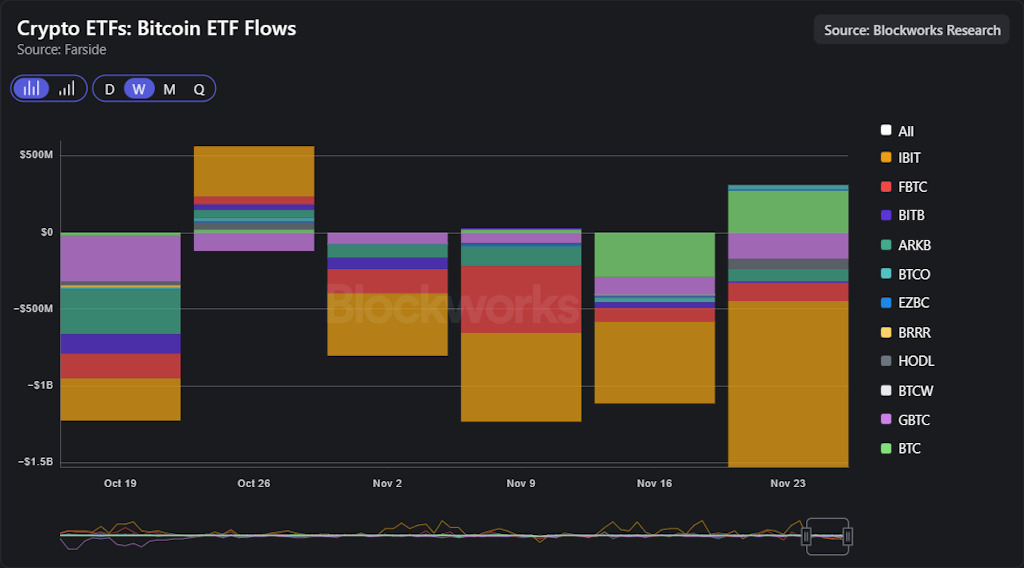
Over the four weeks, US spot bitcoin ETFs have seen consistent net outflows, with each of the last three weekly bars recording over $1 billion in withdrawn funds. IBIT has been responsible for the largest share of redemptions, while smaller but steady outflows also appear across funds like FBTC, BITB and ARKB. Overall, the trend reflects sustained investor derisking, with cumulative withdrawals building into late November.
Nubank is one of the world’s largest digital financial services platforms, operating in Latin America with over 127 million customers as of Q3 2025. Nubank has an impressive activity ratio of 83%, and like many neobanks, has no physical branches. The company has become a major crypto gateway with 6.6 million crypto users (up 42% YoY) and transaction volumes jumping 250% after eliminating exchange fees. Future initiatives include a US bank charter application and a pilot for dollar-pegged stablecoin payments (Read more).
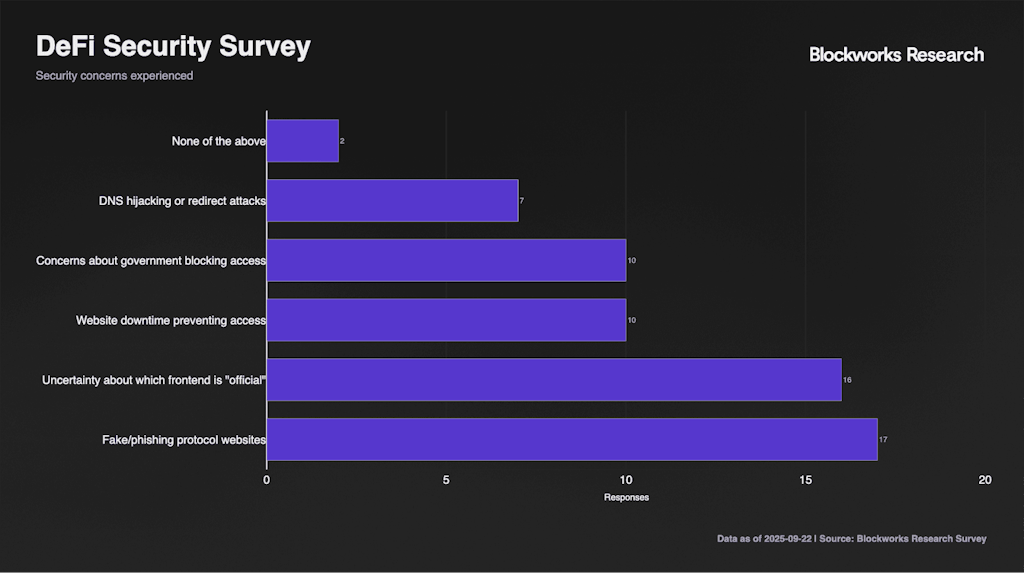
Survey data confirms user awareness of these threats. Among respondents to our survey, 88% identify connecting to malicious sites as their primary concern, compared to 77% citing smart contract vulnerabilities. These results show that the market recognizes that frontend attacks are a significant threat vector (read more).
Get the news in your inbox. Explore Blockworks newsletters:
- The Breakdown: Decoding crypto and the markets. Daily.
- 0xResearch: Alpha in your inbox. Think like an analyst.