Evergrande Default Adds to Market Jitters
Fitch Ratings downgraded the Chinese real estate developer to ‘Restricted Default’ on Thursday, amid restructuring plans that could leave offshore bond-holders taking a haircut.
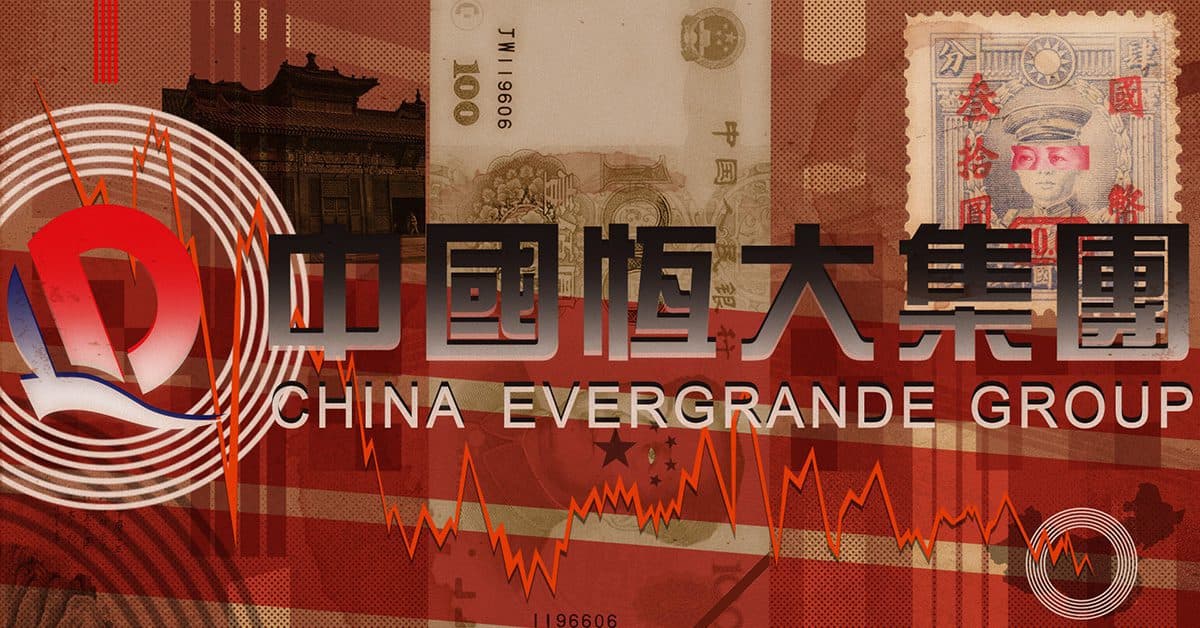
Blockworks exclusive art by Axel Rangel
- Evergrande’s bonds and stock have been trading near their all-time lows this week
- “Watch credit default swap spreads on sovereign debt” for signs of credit contagion, advises Greg Foss
After many close calls for the embattled Evergrande property developer, a failed interest payment earlier this week led Fitch Ratings to downgrade Evergrande’s credit rating to RD (restricted default) — on Thursday.
Markets have been anticipating the potential for defaults on distressed debt from Evergrande for months. The company narrowly averted a default in November, with last-minute interest payments, but on Monday, two bonds issued by Scenery Journey Ltd., passed their 30-day grace period, Fitch wrote, triggering the downgrade.
Evergrande subsidiary Tianji Holding Ltd. owed the specific interest payments. Their non-payment opens up the potential for cross defaults on the parent’s offshore notes as well, totaling $19.2 billion of dollar debt, as reported by Bloomberg.
Fitch noted in their downgrade notice that the “restricted” classification comes as “there has been no initiation of bankruptcy filings, administration, receivership, liquidation, or other formal winding-up procedures as yet with business operations continuing.”
In an exchange filing a week ago, Evergrande stated it plans “to actively engage with offshore creditors to formulate a viable restructuring plan of them Company’s offshore indebtedness for the benefit of all stakeholders.”
Evergrande’s bonds have been trading for 20 cents on the dollar, near their September lows, and its stock fell Monday to a new low.
Government reaction
People’s Bank of China (PBoC) Governor Yi Gang sought to downplay the risks to financial markets during recorded remarks on Thursday for a seminar held with the Hong Kong Monetary Authority, according to the Wall Street Journal:
“The risk caused by a few real-estate firms in the short run would not undermine the market for the medium and the long run,” Mr. Yi said.
The PBoC cut the reserve requirements for banks on Monday, injecting the equivalent of about $188 billion of stimulus, a sign of its efforts to contain the crisis.
“The [PBoC] eased to help smooth the ‘default.’ In reality, the default has been priced in and anticipated for six months. The real issue will be credit contagion. Watch credit default swap spreads on sovereign debt as a warning signal,” Greg Foss, executive director of strategic initiatives at Validus Power Corp, told Blockworks.
That contagion could hit offshore creditors hard, as any restructuring plan would likely prioritize the millions of Chinese homeowners who put up down payments on Evergrande developments, as well the company’s employees and local suppliers, and any other investors who have more senior claims.
One question is where the Chinese leadership’s priorities will lie if credit conditions worsen. In Thursday’s comments, Yi Gang blamed Evergrande’s problems on its “own poor management and reckless expansion.”
Political concerns are trumping economic ones, according to analysis from the Center for Strategic & International Studies.
“Beijing’s reaction to financial stress has clearly changed…One of the reasons that the Evergrande crisis is spreading to global markets is that investors can no longer be certain that Beijing is trying to maintain the same economic growth rates as in the past,” Logan Wright, director of China markets research at Rhodium Group, wrote in October.
Bitcoin was down 7% yesterday, and has failed to get back above the $50,000 mark in Friday trading. In the past, Evergrande’s problems have been correlated with weakness across the asset spectrum, although major international equities markets have remained relative unfazed this time around compared with major digital asset names.
Get the day’s top crypto news and insights delivered to your inbox every evening. Subscribe to Blockworks’ free newsletter now.