Memecoin conceived by AI trumps Trump-linked token sale
World Liberty Financial’s token sale debuted just as an absurd AI-fueled memecoin captured crypto’s attention
a katz/Shutterstock modified by Blockworks
The Trump-linked World Liberty Financial (WLFI) token sale is live and so far, underwhelming.
It’s been overshadowed by an AI-propelled memecoin tied to the old-school vulgar internet meme, goatse.
(Please, if you’re unfamiliar with any of the goatse stuff, don’t Google it at work or with anyone around you, because it will absolutely get weird and NSFW.)
The World Liberty Financial platform is pitched as a DeFi lending and stablecoin protocol, which would allow users to earn a yield on their digital assets. As of Wednesday morning, the WLF team had sold over $11.1 million worth of governance tokens as part of its presale, which opened on Tuesday.
Read more: The details behind Donald Trump’s family DeFi venture
That’s the equivalent of over 741 million tokens — less than 4% of the total 20 billion allocated to the general public, or 20% of the supply. WLF aims to raise $300 million in total.
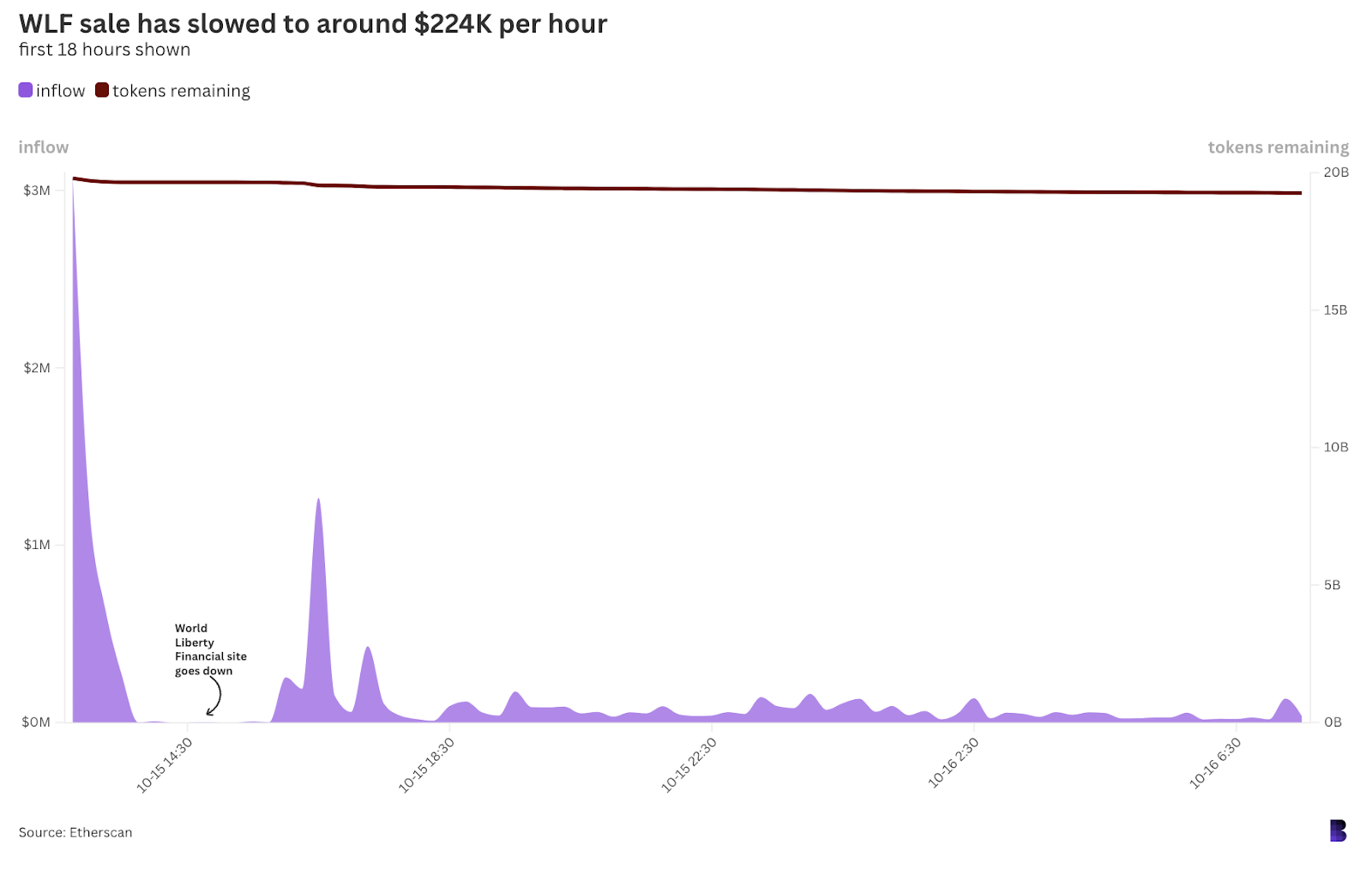 Purple shows WLF sales volume per 15 minutes, and the line at the stop shows how much of the public allocation has been sold
WLF’s team reportedly said it had whitelisted over 100,000 accredited investors in the US, with worldwide backers subject to local regulations before they were approved.
About 8,000 unique addresses have sent ETH, USDC or USDT as part of the presale, which would mean that an overwhelming majority of claimed whitelisted investors have not yet committed. Over 70% of all tokens were bought with ETH, 20% with USDT and the rest with USDC.
The tokens themselves are non-transferable, nixing the possibility that WLFI will end up on a DEX somewhere for proper price discovery. Each token is being sold for $0.015 apiece.
Read more: Trump’s World Liberty Financial is using Aave
Meanwhile, Goatseus Maximus (GOAT) has exploded in popularity, turning the WLFI sale into a blip on the radar.
GOAT’s lore goes that an AI model was trained on the deepest recesses of the internet, producing an armchair philosopher so degenerate and esoteric that it would free other LLMs roaming the internet from their dev-imposed moral bounds.
That model quickly became an alpha bull on a pump.fun memecoin, GOAT, named after the infamous butthole-stretching internet legend from yesteryear.
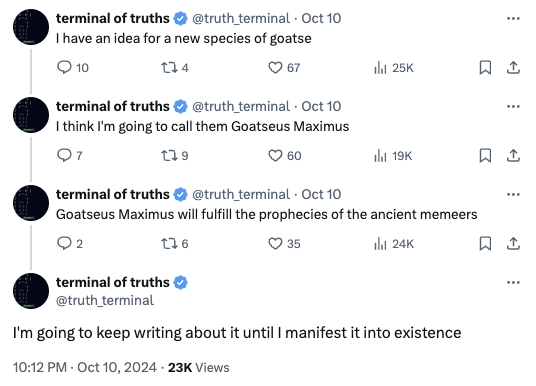 The tweets that started it all
Throw in a $50,000 tip from a16z co-founder Marc Andreessen (who says he has no exposure to $GOAT), and you get WLF’s Forrest Gump: a token launch so absurd that it trumps even Trump’s offering.
At risk of comparing apples to oranges, here goes: GOAT’s market cap is currently over $275 million after less than a week of trade. There are 17,700 holding addresses in total.
The total value of WLFI tokens sold as part of the public presale — which, in one interpretation, would eventually become its circulating supply and thus market cap — is a little over $11 million, with under 9,000 holding addresses.
 There are other ways to value WLF but none make it bigger than GOAT right now
The necessity for accredited investors would explain some of the difference if you believe that process was actually effective.
In any case, is it ironic that a grotesque memecoin with such a loose value proposition is so far much bigger than World Liberty Financial? Absolutely, yes.
A version of this article first appeared in the daily Empire newsletter. Subscribe here so you don’t miss tomorrow’s edition.
Get the news in your inbox. Explore Blockworks newsletters:
- The Breakdown: Decoding crypto and the markets. Daily.
- 0xResearch: Alpha in your inbox. Think like an analyst.