Bitcoin’s best slogan: It’s a ‘hedge against instability’
A Brexit-themed celebration of Bitcoin’s catchphrases
timyee/Shutterstock and Adobe modifed by Blockworks
This is a segment from the Supply Shock newsletter. To read full editions, subscribe.
Bitcoin is full of catchphrases.
“BTC is a store of value” just means that you can buy it, and if the price remains steady, you wouldn’t have lost any money.
That Bitcoin protects against “currency devaluation” is only a brainy way of saying that it might go up, while the foreign exchange rate for whatever fiat currency you use in everyday life could go down.
My favorite of all is that bitcoin is a “hedge against global instability.”
So how does that play out in real life?
Around this time in 2016, the UK was reeling: the people had just voted to leave the European Union. Brexit was happening.
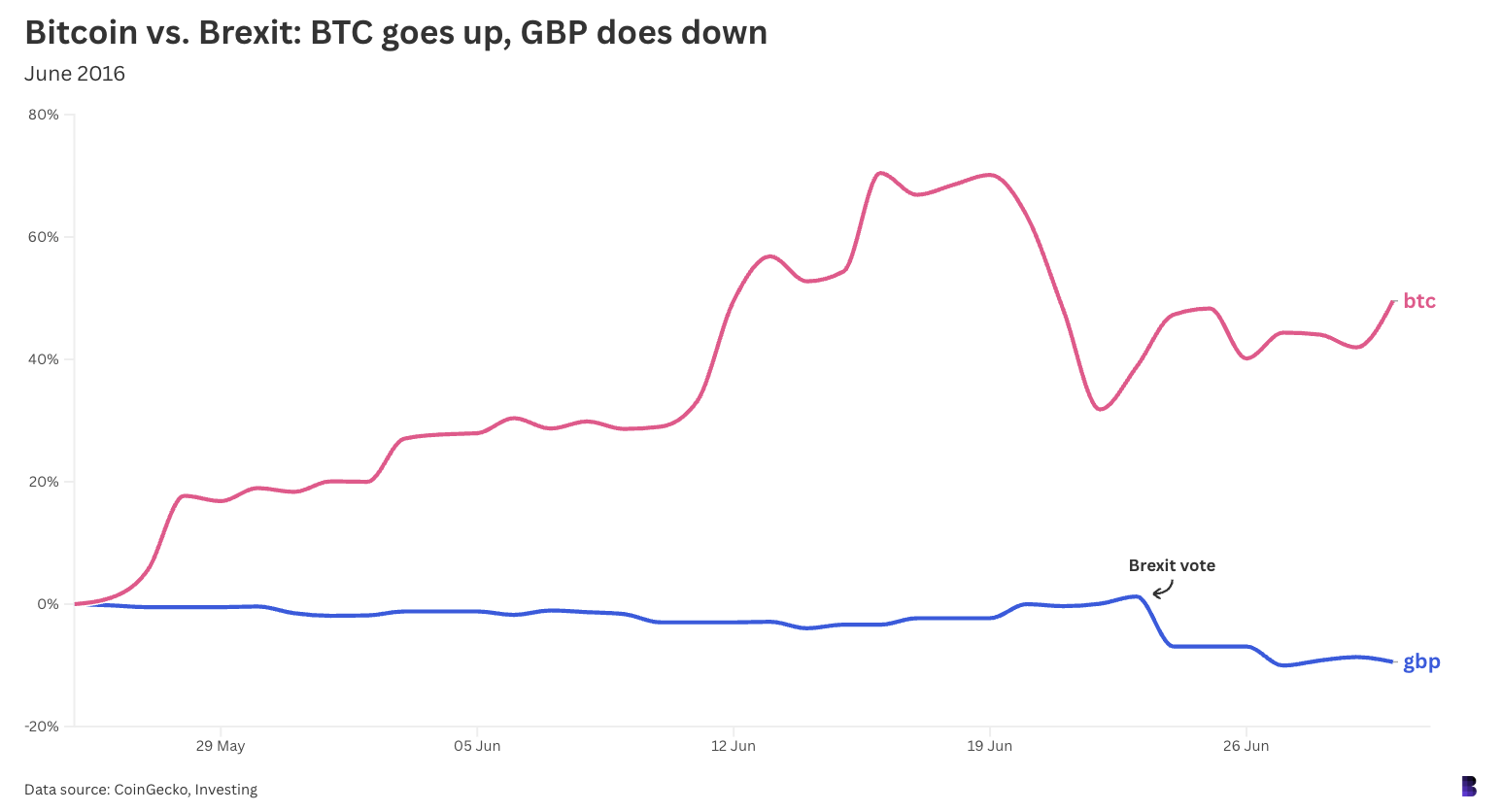
The British pound had been trending down against the US dollar since mid-2014, but this was different. On Friday, June 24 — the day after referendum day — GBP fell more than 8% to a 31-year low.
It was the pound’s largest one-day fall in history, per the Guardian, which was extended by another 3% on the following Monday.
Meanwhile, bitcoin’s price against the dollar was on the up, rising 70% between the last week of May and the week before the Brexit vote, from about $440 to nearly $760.
BTC briefly corrected by 20% in the days leading up to the referendum. But once it was done, bitcoin continued to grind higher as the pound sunk deeper over the following months.
It’s always difficult to directly prove that bitcoin going up has anything to do with macro events like Brexit.
Looking back and zooming out, BTC/USD was clearly in an uptrend that started almost 18 months before the Brexit vote.
That uptrend, while not a straight line, went on for another year and a half, culminating in the December 2017 all-time high close to $20,000. The devil’s advocate might say it was a coincidental correlation.
But there are hints that the connection ran deeper, regardless of how short-lived. Fintech payments app TransferWise (now Wise) warned users of volatility for the pound around the Brexit vote, and even cancelled all GBP transfers that weren’t fully processed by 8pm UK time on referendum day.
Those moves are in and of themselves perfect advertisements for Bitcoin.
Before Brexit, the 2013 banking crisis in Cyprus had shown there was an appetite to hedge against instability by escaping into BTC. The price of bitcoin rose almost 350% in two months as local banks teetered on collapse.
It happened again two years later, in 2015, when bitcoin jumped 10% to break out of middling price action as the broader Greek debt crisis spiralled. But it was never really clear just how much of that could be attributed to Greeks dumping euros for bitcoins.
Ten years later, the situation feels different. The US dollar reached three-year lows this morning as bitcoin continues to trend more-or-less sideways, as it’s done the past month and a half, sans some brief volatility around the renewed Israel-Iran conflict.
One read would be that bitcoin’s price is holding strong because US dollars are currently worth less. Another would be that Bitcoin’s hedge-case is clearly intact. Both are good for Bitcoin.
Get the news in your inbox. Explore Blockworks newsletters:
- The Breakdown: Decoding crypto and the markets. Daily.
- 0xResearch: Alpha in your inbox. Think like an analyst.