Do tokens need fundamentals?
Framework’s Michael Anderson explains what tokens need in order to be successful
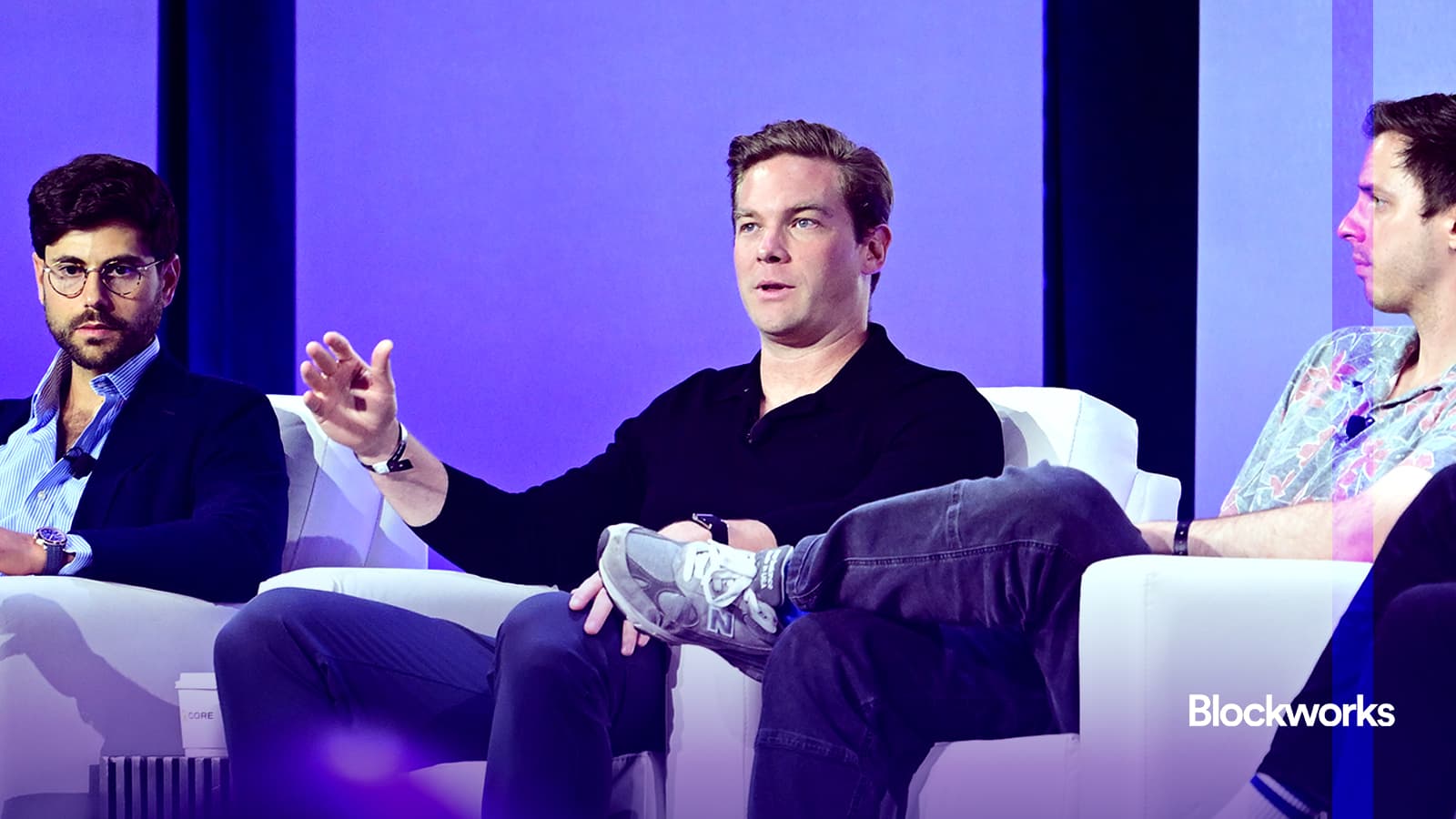
Framework Ventures cofounder Michael Anderson | Permissionless IV by Ben Solomon for Blockworks
This is a segment from the Empire newsletter. To read full editions, subscribe.
I know Permissionless is over, but let’s take it back to the main stage one more time. Specifically, I want to focus on the Bell Curve x Empire Round Up.
One of the most interesting parts of the conversation between Blockworks co-founders Mike Ippolito and Jason Yanowitz, Framework’s Michael Anderson, and Inversion’s Santiago Santos is the idea that crypto could — at some stage — have its own version of the Mag 7 (a term coined to describe the “magnificent seven,” or some of the top stocks over on Wall Street).
“The meta-narrative is: Tokens need to make money. Tokens need to have a business model. There needs to be a value accrual to the token, just in the same way that there is to Robinhood and Coinbase or anything else that’s publicly traded and we don’t have GAAP accounting,” Anderson said.
“The next step is going to be: How do we get GAAP accounting so that everybody can look at these things on an apples-to-apples comparison basis? And if you’re making money, then you have a shot at being in the Mag 7. If you’re not, you don’t have a shot.”
At this point, Anderson thinks that pump.fun, when it launches a token, could be considered part of crypto’s top tokens. But he also thinks that BNB, Binance’s native token, has the “best token model that exists.”
“As US persons, we’re not allowed to be Binance customers, and therefore nobody knows about it, but that is the fundamental basis of BNB. Not only is it 20% or 25% of the profits, which I don’t think is actually the case anymore, that’s how it started…Now, BNB is — if you stake BNB within Binance, you get discounted fees, but you also get airdrops of any tokens that are listed on Binance, which you can sell — and they do — immediately.”
Meanwhile, Santos says that the focus right now is very heavily on: What’s the next public crypto company (not meaning a SPAC or Treasury vehicle, but an actual crypto firm), and how can investors get a piece of the pie like Circle, Robinhood or Coinbase?
“I would probably take the bet that more and more liquidity is going to go in the public markets,” he said, adding that folks are more likely to look at ETFs and crypto stocks than tokens currently.
And that, I would say, was a pretty constant theme of Permissionless. I, admittedly, wasn’t there in person, but I watched nearly all the panels via livestream, and the themes were pretty dang obvious.
Stablecoins took up a whole lot of space, alongside discussions of how the industry improves token frameworks; and of course everyone’s curious about the next company to debut via the public markets. If the rumors are to be believed, it’s quite a long list.
Get the news in your inbox. Explore Blockworks newsletters:
- The Breakdown: Decoding crypto and the markets. Daily.
- 0xResearch: Alpha in your inbox. Think like an analyst.