World’s killer consumer app might be UBI — but it all hinges on price
Sam Altman sees our future through the World Orb
Olgadesigner/alleachday/Shutterstock and Adobe modified by Blockworks
This is a segment from The Drop newsletter. To read full editions, subscribe.
“Crypto” as a term is losing its meaning.
And that’s okay. It’s a good thing, even.
Crypto is an asset class, a technology and a community, all at the same time. Soon, it will be necessary to be very specific when discussing any of its aspects.
This is true at high and low levels of analyzing what crypto really is. Does Bitcoin compete with Ethereum? As far as their technologies go, not really. But there’s an argument to be made that BTC and ETH do compete as assets.
Does Ethereum compete with Solana? For sure, as both a technology and an asset. How about World and its native token worldcoin (WLD)?
On the surface, World is absolutely similar to any other blockchain with its own ecosystem of apps and protocols.
The official Worldcoin wallet aside, the top apps on the network are various third-party wallets, apps that dish out tokens for various tasks or otherwise let users stake tokens in return for yield. Fairly cookie-cutter by today’s standards.
Of course, World and WLD are largely unique because of the Orb, the biometric scanner that’s meant to human-proof the internet from its inevitable AI overlords.
There are valid critiques of World’s vision of the future (and its present, for that matter). But what’s often overlooked is that its co-founder Sam Altman really wants universal basic income to play a central role in whatever life humans will live around the Singularity.
Separately to World and Tools for Humanity, Altman has already run an $60-million, three-year UBI experiment with 3,000 participants across Texas and Illinois. “We do see significant reductions in stress, mental distress, and food insecurity during the first year, but those effects fade out by the second and third years of the program,” the researchers found, but the maximum payments of $1,000 per month were just not enough to solve challenges such as “chronic health conditions, lack of childcare, or the high cost of living.”
WLD, in essence, has the blockchain bones of a crypto-powered UBI scheme via its year-long grants program, which pays a small sum of tokens to anyone who has verified through the World App, be it by feeding their biometrics to the Orb or by submitting their government-issued IDs, such as passports.
Recently, the total number of individual users who have received at least one grant ticked over to 12 million (about a quarter of the combined population of Texas and Illinois).
Those users have altogether received more than 595 million WLD to date, which at current prices (WLD = ~$1) puts the total value of the verification grants at $595 million — nearly 10 times the value of the previously referenced UBI study.
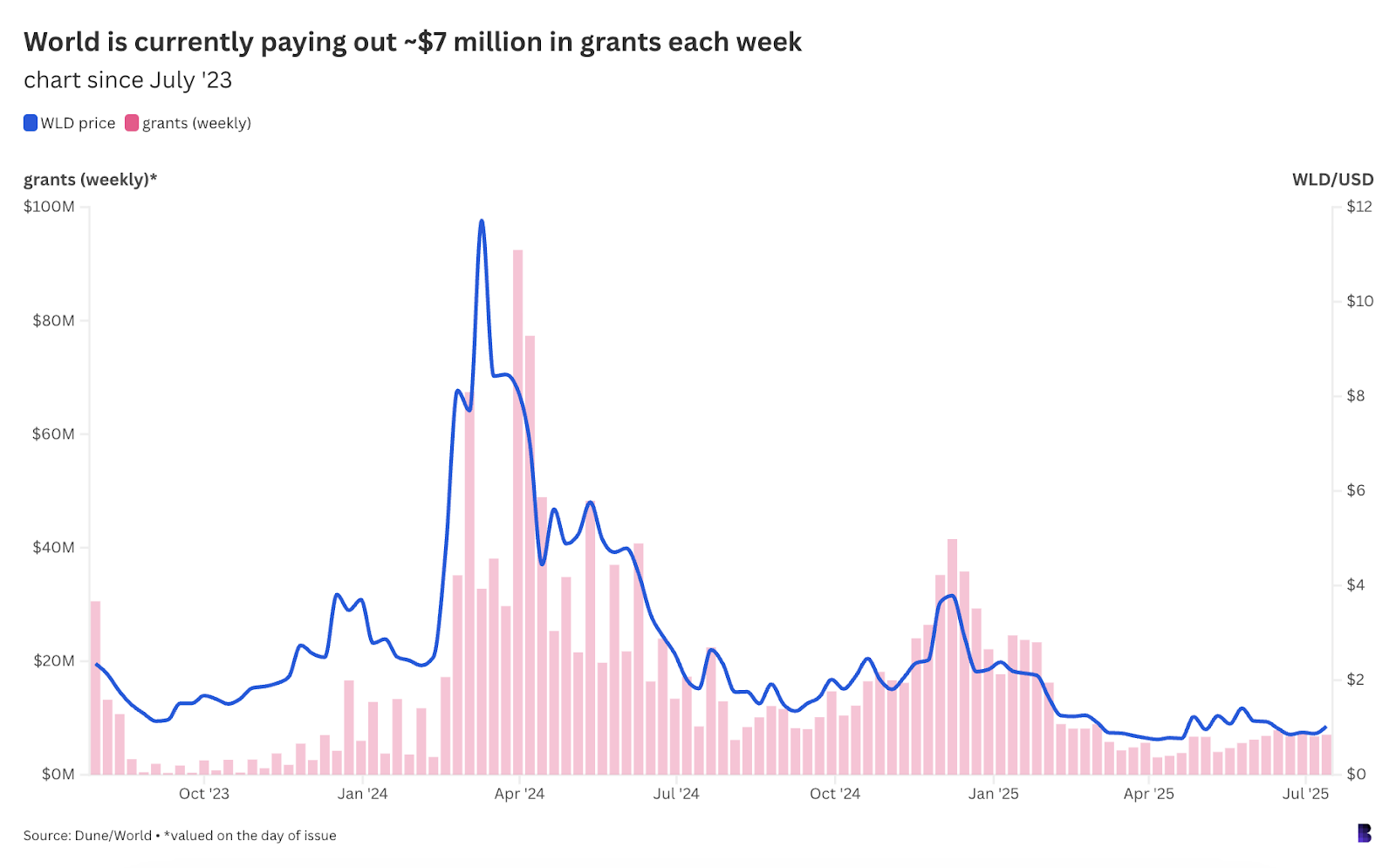
But the price of WLD has reached as high as nearly $12. So, if we value the grants at the approximate time of distribution — accounting for users potentially dumping their tokens as soon as they receive them — the total value of WLD grant distributions moons to $1.61 billion.
On average, each user has received around 50 WLD as part of the grants program, worth only about $50 right now but closer to $600 at all-time highs. And it’s likely the real value that recipients unlocked sits somewhere in the middle-to-low end of that scale.
That’s obviously lower than the $1,000 per month paid out in Altman’s previous real-world UBI trial, so the effectiveness of World’s quasi-UBI scheme is questionable at best. But when it comes to World, its grants program might be the closest thing it has to a killer app, at least at the consumer level, with integrations with platforms, businesses and so on rounding out the rest of its potential.
Awkwardly, this would place tokenomics at the vanguard of humanity’s last line of defense for the AI takeover, which by the way things are going, sounds just about right to me.
Get the news in your inbox. Explore Blockworks newsletters:
- The Breakdown: Decoding crypto and the markets. Daily.
- 0xResearch: Alpha in your inbox. Think like an analyst.