Solana is speedrunning Ethereum’s bitcoin ratio chart
SOL and ETH are actually sharing similar trajectories against the price of bitcoin
ddRender/Shutterstock modified by Blockworks
This is a segment from the Empire newsletter. To read full editions, subscribe.
So much has been made of the underperformance of ETH.
Turns out, SOL is on track to match it almost to a tee.
A few weeks back, I pointed out that ETH is speedrunning the Intel stock chart — doing what Intel has done over the past 50 years in about a decade.
Here’s another in the series: The SOL/BTC ratio is on an almost identical path to the ETH/BTC ratio.
Below plots the price of both ETH (green) and SOL (purple) in terms of BTC (their bitcoin ratios), with some caveats:
- The SOL/BTC data begins 10 months into its trading history, in February 2021 rather than April 2020.
- SOL/BTC has been moved forward to match ETH, as if both coins were launched at the same time.
- ETH/BTC is sped up by 2x, which condenses two days of price action into one.
As you can see, the ETH and SOL bitcoin ratios are mapping eerily similar trajectories.
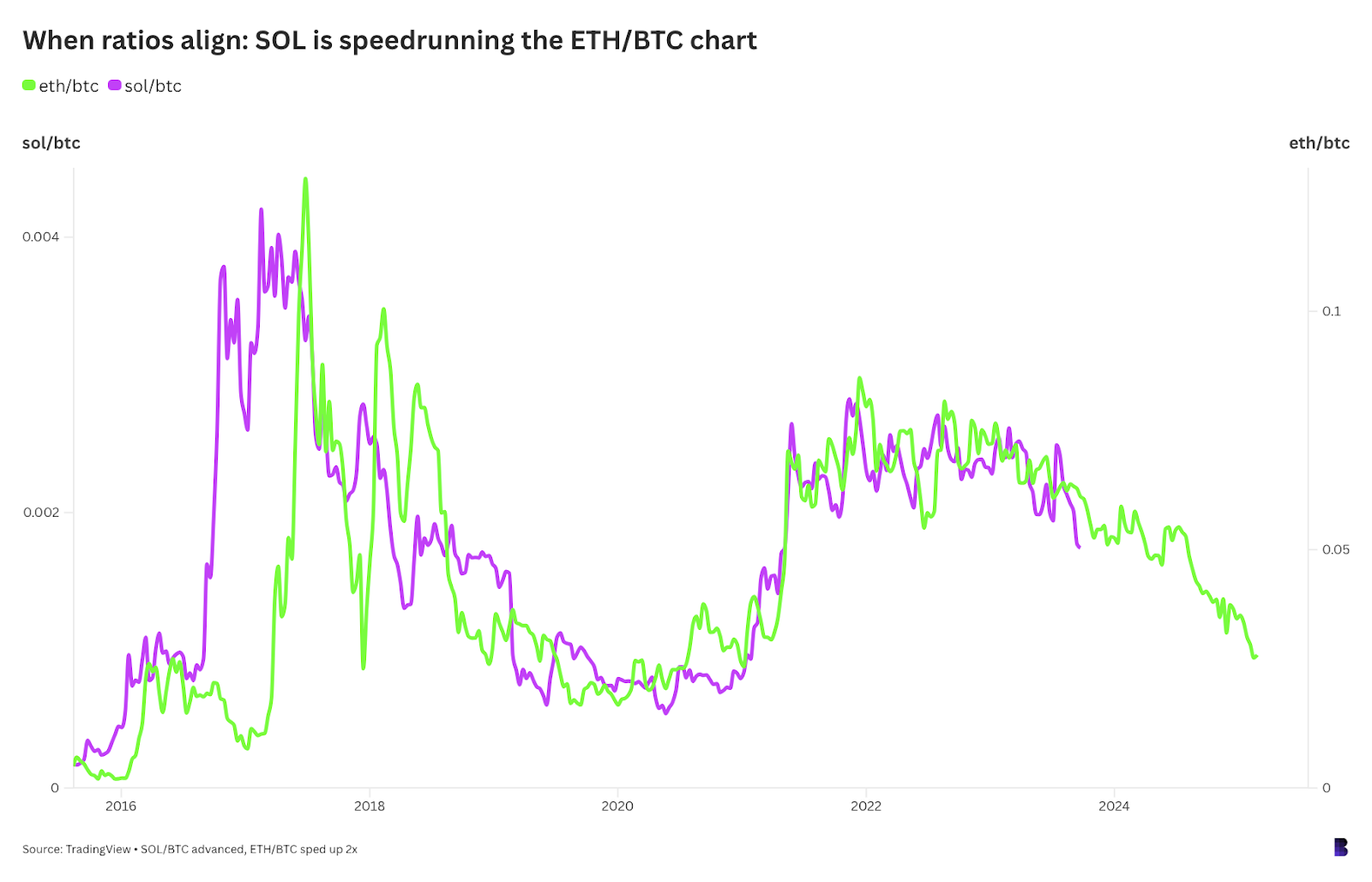
Both underwent large initial spikes of price discovery against BTC during their first bull markets — ETH in 2017 and SOL in 2021 — before collapsing throughout bear markets.
Then they posted comparatively lackluster returns against bitcoin in the following bull market cycle: ETH/BTC mostly trended sideways between May 2021 and January 2023 but has since tanked by more than 60%.
SOL/BTC has otherwise gone not much of anywhere between December 2023 and today. This would put SOL/BTC about where ETH/BTC was in mid-2023 — before the latter slid from 0.07320 BTC to 0.028 BTC over the next year and a half.
So, if SOL is indeed destined to track ETH relative to BTC, then the price of ETH going up against the US dollar — and fast — would surely help matters.
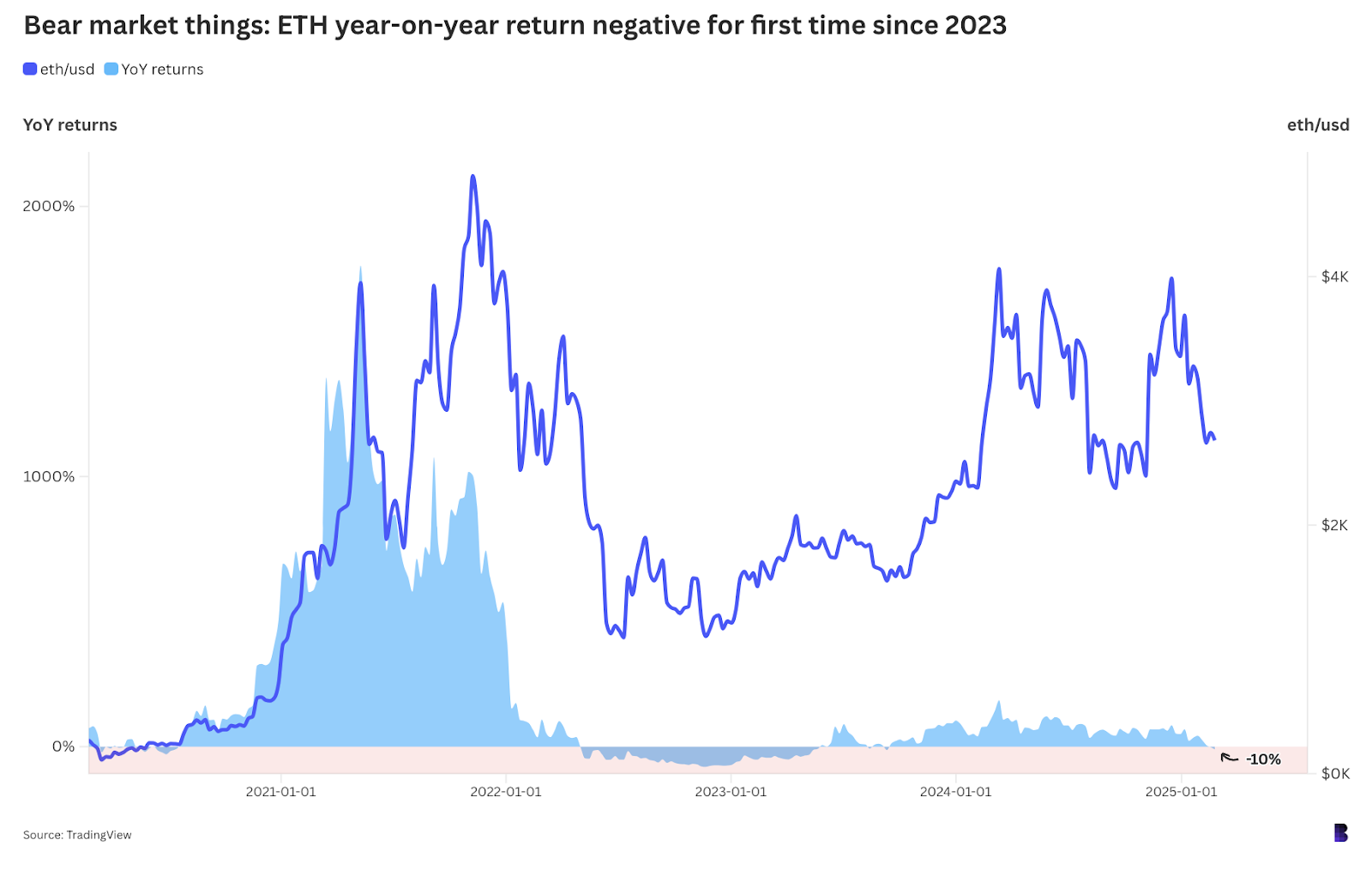
Bad news: ETH has technically entered a bear market. At least, that’s by one very basic definition, which suggests that a coin is in a bear market when its year-on-year returns are negative and vice versa.
It’s the same theory that says bitcoin’s most recent bear market, which spanned 490 days between February 2022 and June 2023, was its longest on record. ETH’s year-on-year returns were negative for almost that entire period.
As it turns out, ETH’s year-on-year returns (minus staking) again flipped negative 10 days ago, on February 14. That’s a first since June 2023 — which is either the very early innings of the current bull market or the very final moments of the previous bear market, depending on how you look at it.
Get the news in your inbox. Explore Blockworks newsletters:
- The Breakdown: Decoding crypto and the markets. Daily.
- 0xResearch: Alpha in your inbox. Think like an analyst.