Verifiable AI took center stage at DAS London with EigenCloud
Eigen Labs’ J.T. Rose pitched verifiable off-chain compute with agentic AI coming to Ethereum
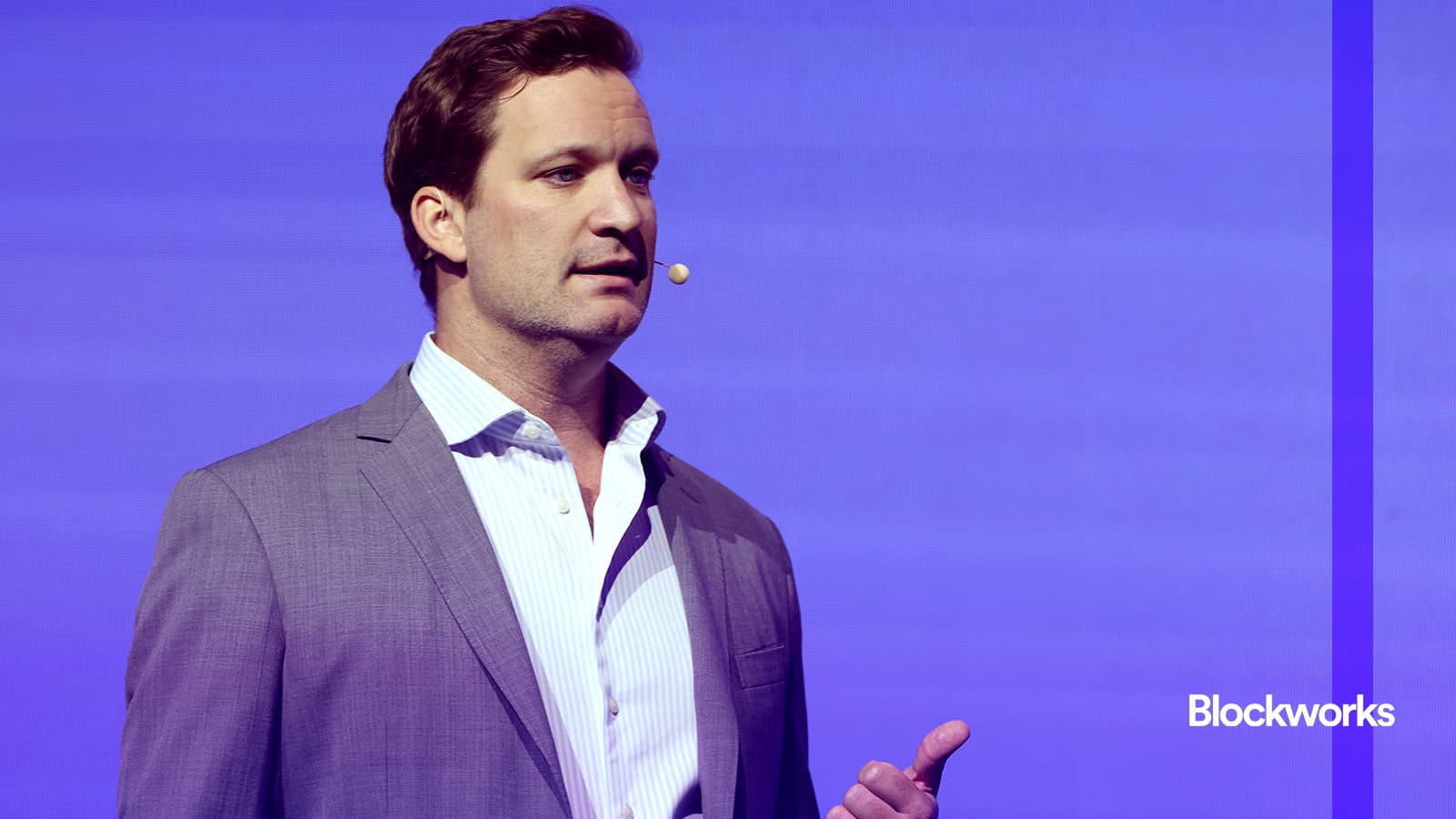
Eigen Labs CGO J.T. Rose | DAS London 2025 by Ben Solomon for Blockworks
At DAS London, Eigen Labs’ J.T. Rose argued that crypto’s next leg won’t be DeFi but “verifiable AI” — agentic systems whose off-chain work can be proven on-chain.
Rose cast Eigen’s stack as a cloud-like trio of services (data, compute, inference) backed by crypto-economic security and proofs, letting developers keep public-cloud flexibility while adding verifiability before funds move or state updates land on Ethereum.
Three promising use cases are coming to the fore, according to Rose:
- Autonomous trading agents that must prove they followed risk rules;
- Agent-to-agent (A2A) payments where work receipts trigger settlement and;
- Gaming with attestable outcomes.
“The single most important limitation we see for [Artificial Intelligence] founders over the next decade is trust,” Rose said. “Without a mechanism to make AI verifiable up and down the stack — from inference and benchmarking to training and identity — we’ll never hit escape velocity for the agentic era.”
The common thread is programmability meets provability — “programmability like a cloud, assurances like a blockchain,” as Rose framed it — a response to today’s trade-off between tightly constrained on-chain execution and opaque off-chain compute.
David Sneider, co-founder of Lit Protocol, largely shares the destination, focusing on the properties which can instill trust in AI agents, like “guardrails and policies,” synonyms to promote correct execution.
“[As] with anything with security, there’s multiple components in terms of different types of attacks and how you guard against them,” Sneider told Blockworks, arguing that runtime enforcement — not just after-the-fact proofs — is what turns agents from demos into dependable infrastructure.
In Lit Protocol’s design, Sneider said, a user might tell an agent, “Send an email or buy a bitcoin,” in which case “it communicates with Lit, which validates against the policies…and only if the policy passes, the secret management network then executes.” By “secret management network,” Sneider is referring to Lit’s TEE-secured, MPC-based key infrastructure.
Taken together, Lit handles the “Can the agent act on my behalf?” question. EigenCloud and Google’s AP2 handle “Can I trust the result of this offchain computation?”
Or, to simplify the full trust stack:
- An agent asks: Am I allowed to do this? (Lit)
- Execution proves: Did I do what I said? (EigenCloud/AP2)
Rose outlined a range of alternatives on the verifiability spectrum, such as TEEs, crypto-economic slashing and zk proofs. Lit can emit success/failure signals and policy-compliance proofs for each execution, but they’re often kept internal. The roadmap is to surface those attestations “in privacy-preserving ways into shared registries like ERC-8004 and inter-agent communication protocols like A2A,” so a compliant agent doesn’t need to be re-audited in every venue.
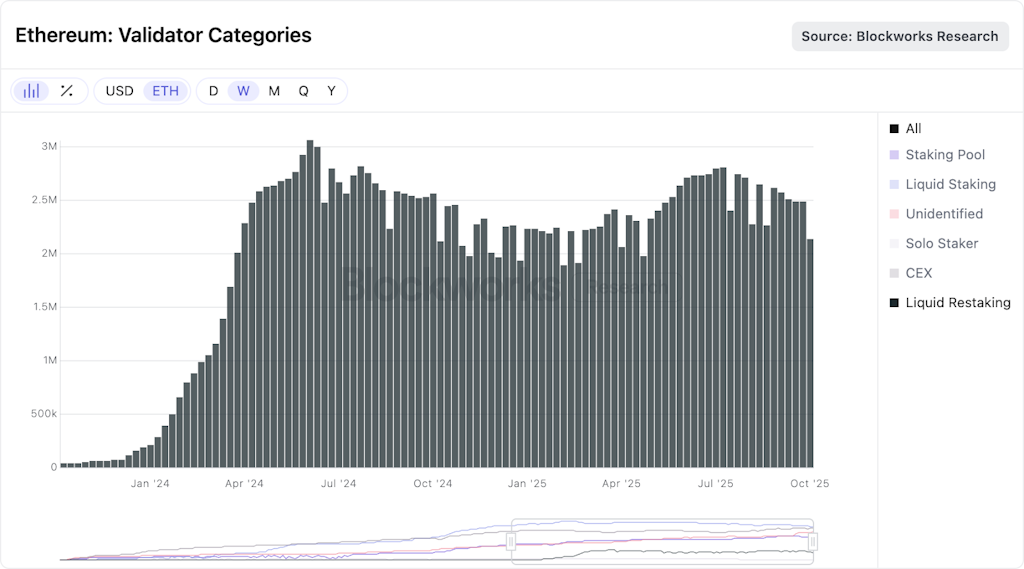
Restaked ether has held steady between 2-3 million ETH, mostly with EigenLayer | Source: Blockworks Research (Entity labels sourced from Dune’s staking flows table.)
Both founders converge on Ethereum as the neutral trust anchor and on a near-term consumer arc.
Soon, “everybody is going to have essentially a quant in their pocket to manage their funds,” Sneider said. It’s an idea that “seems pretty coherent and is starting to come together.”
If all the pieces land — guardrails that travel and compute that can prove itself — both founders see a path from prototypes to production. As Rose put it: “The next growth driver for crypto won’t be DeFi — it’s verifiable AI, and it’ll happen on Ethereum.”
Get the news in your inbox. Explore Blockworks newsletters:
- The Breakdown: Decoding crypto and the markets. Daily.
- 0xResearch: Alpha in your inbox. Think like an analyst.