Exclusive: Monad Foundation acquires stablecoin infrastructure project Portal
Monad Foundation’s Keone Hon said the team’s been “thinking about how to grow the onchain economy for some time”
raigvi/Shutterstock and Adobe modified by Blockworks
This is a segment from the Empire newsletter. To read full editions, subscribe.
The Monad Foundation has acquired Portal, a stablecoin infrastructure provider, the team exclusively told me.
Portal will continue to operate as an independent entity, though it’ll be able to leverage Monad’s technology to serve customers. Portal’s founder, Raj Parekh, will transition to become the Head of Payments and Stablecoins at the Monad Foundation.
The team declined to give financial terms about the acquisition, but Monad Foundation co-founder Keone Hon told me that they’ve “been thinking about how to grow the onchain economy for quite some time.”
The two noted that they have natural synergies and will leverage them to collaborate on things such as bridges and stablecoin wallets.
“When we at the Monad Foundation thought about this acquisition, we were excited both about the opportunity to partner really closely with [Parekh] and the team that he built, as well as to really grow the adoption of this product, and, more generally, to utilize the product to grow the adoption of crypto,” he continued.
The goal for Monad — which is still in testnet, though Hon told me that the team is preparing to launch mainnet “very soon” (he unfortunately wouldn’t give me more than that) — is to become the “blockchain of choice” for stablecoin transactions.
“There’s obviously maturity from a volume standpoint, circulating supply standpoint. The infrastructure at the developer tooling side is improved with things like what Portals built. Newer architectures like Monad now actually allow some of the sharp edge of the blockchain that existed before to now be removed as well. So I think it was a natural maturation phase of the infrastructure layer,” Parekh said.
All of this is aided by the fact that the regulatory shift is supporting stablecoins and the interest in them as well, such that stablecoins have come out on top as the defining narrative this year.
“Now I think folks are starting to see real volume, and use cases like banking…Some of the more boring use cases that you see in payments are starting to proliferate with stablecoins,” Parekh noted.
But for Monad and Portal, it’s about utilizing the groundwork that’s been built to “push the limits of what’s possible in terms of money moving globally,” Parekh said.
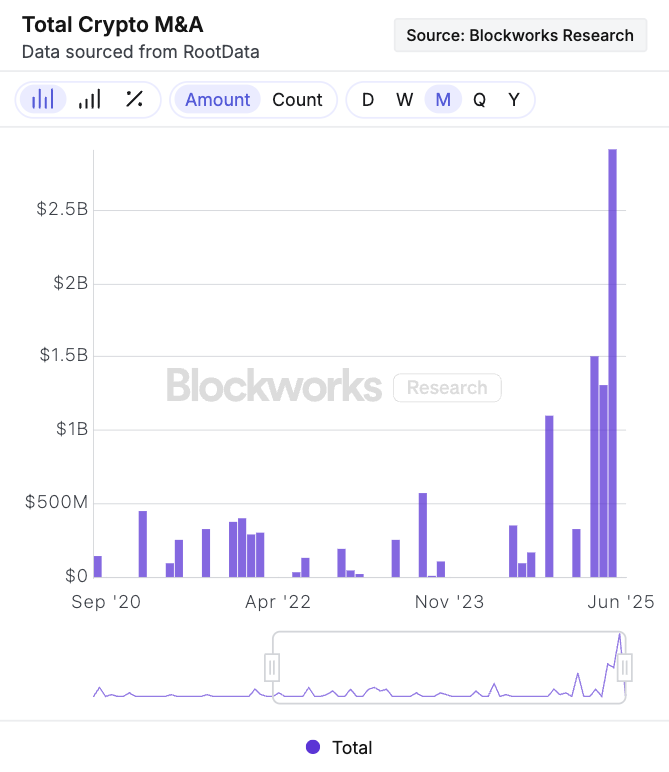
If you pay attention to headlines as much as I do, then you’ll know stablecoins aren’t the only trend we’re seeing pick up in the space. M&A activity is on the rise, as you can see in the chart below from Blockworks Research.
Perhaps unsurprisingly, a lot of the deals were for projects in the financial sector of crypto.
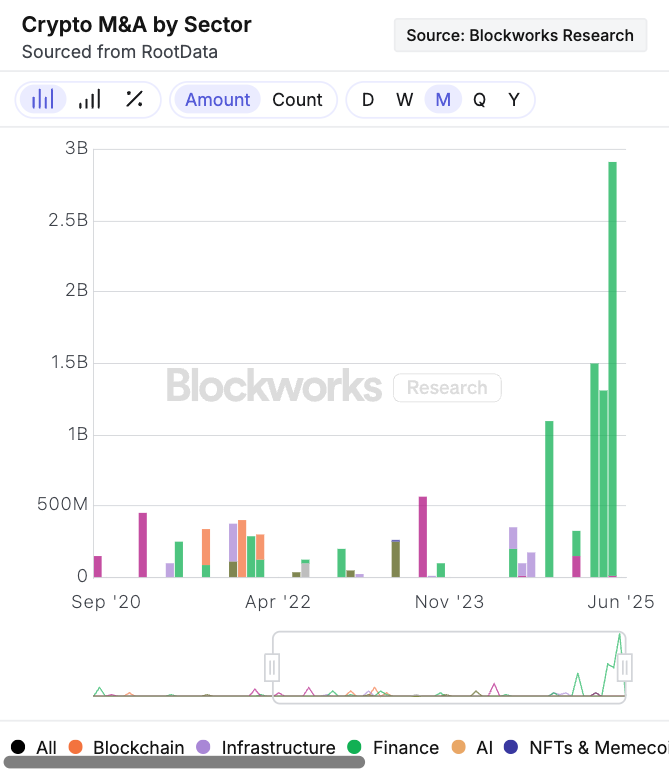
But consumer has also seen a pick-up in activity. Take OpenSea’s acquisition of Rally yesterday, for example. Thesis, Worldcoin and Stripe also made consumer-focused acquisitions.
Not to mention that Coinbase made yet another acquisition just last week when it announced it was buying LiquiFi for an undisclosed amount.
Consolidation is a good sign in this space, and shows just how much various sectors are heating up.
Get the news in your inbox. Explore Blockworks newsletters:
- The Breakdown: Decoding crypto and the markets. Daily.
- 0xResearch: Alpha in your inbox. Think like an analyst.