Privacy is not a ‘natural’ right — it’s an invention
From passageways to penumbras: a history of private life
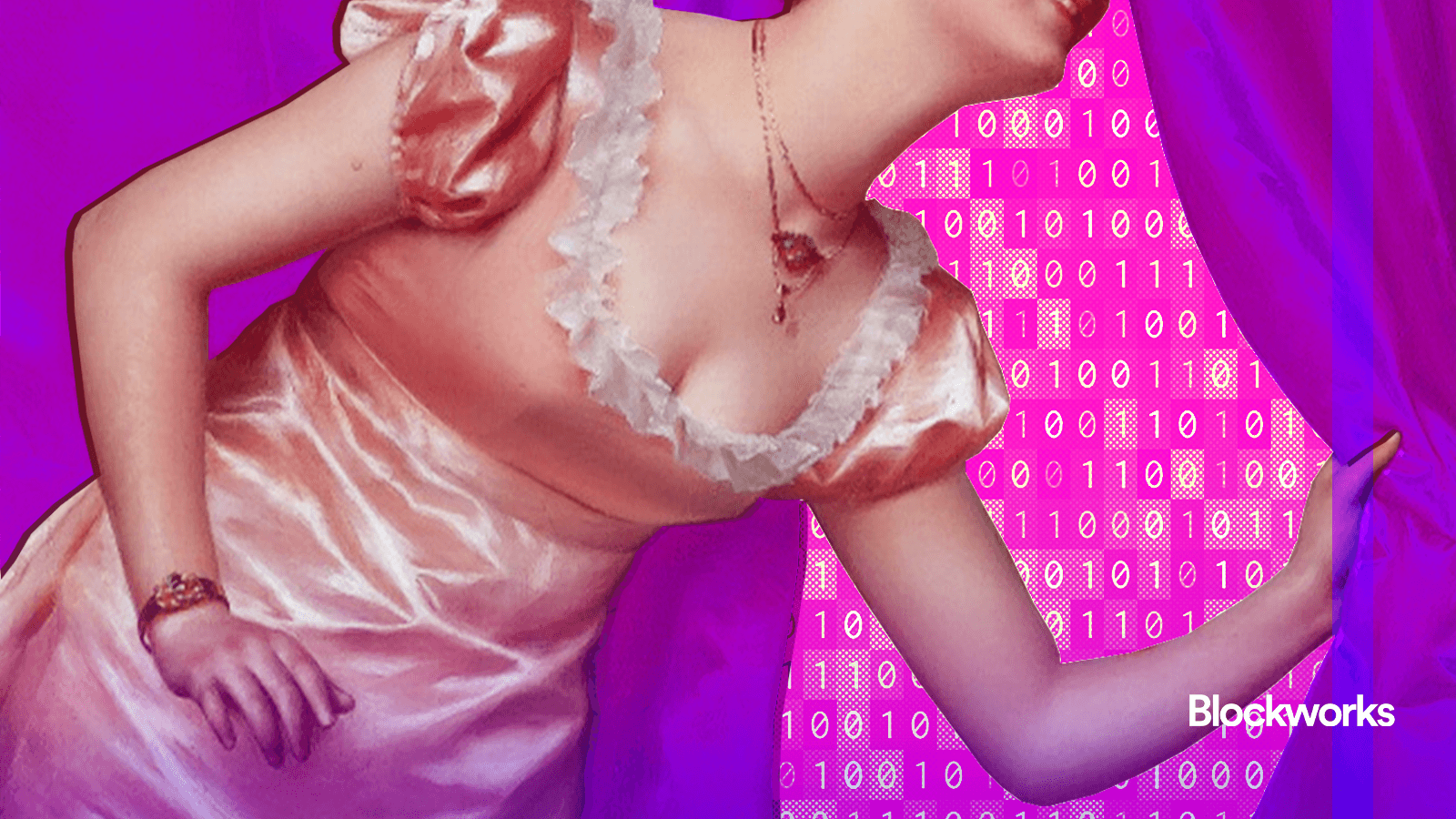
"Eavesdropping" | Vittorio ReggianiniEavesdropping" (Public domain"), and Pavel Skrytski/Shutterstock and Adobe modified by Blockworks
This is a segment from The Breakdown newsletter. To read full editions, subscribe.
“It is essential for human flourishing that we conduct substantial parts of our lives unobserved.”
— Tiffany Jenkins
Hallways were the first privacy tech.
In 1716, the Duchess of Marlborough questioned the architect designing Blenheim Palace because of all the long, narrow rooms he had planned. The architect had to explain that these were “no more than a passage” between rooms.
Another contemporary builder articulated the purpose of this revolutionary new design: “All the Rooms in this House are private; that is, there is a Way into each of them without passing through any other Room.”
In other words, hallways created privacy.
“It took a century for this architectural feature to become commonplace,” Tiffany Jenkins writes in Strangers and Intimates; the Rise and Fall of Private Life. “But once it did, the Victorians embraced it wholeheartedly.”
Before the time of hallways, “there was no strictly separate private sphere, no aspect of life where others could not legitimately intrude,” she explains. “The outside world could pry into anyone’s business and was expected to do so. Curiosity and nosiness were mandated.”
Counterintuitively, that began to change with the Puritans, whose insistence that matters of religion and conscience were private freedoms established the first barrier the state could not cross.
Once established, this zone of non-interference expanded into a Victorian definition of privacy that protected bedrooms, communications and commerce.
In 1844, the privacy zone was tested when the British government was caught opening the letters of the political exile Giuseppe Mazzini to snoop on his correspondence with Italian revolutionaries.
Mazzini proved the surveillance by having friends mail him grains of sand and poppy seeds. When the letters arrived otherwise empty — the grains having fallen out during the government’s clumsy inspection — the breach of privacy sparked national outrage.
Thomas Carlyle called opening a man’s letters a “scoundrelism” equivalent to picking his pocket.
Radical MP Thomas Duncombe said the practice was “subversive of the public confidence essential to a commercial country.”
Most tellingly, the plots of two Charles Dickens novels — Bleak House and Little Dorrit — revolved around stolen letters that threatened to expose family connections and economic dealings.
All of which confirmed, as Tiffany Jenkins says, that “a revolution in the value and esteem of privacy had taken place.”
But while Victorians were the first to embrace this cultural ideal, the United States was the first to write it into law — sort of.
In 1890, Samuel Warren and Louis Brandeis published The Right to Privacy — a foundational article arguing for a fundamental “right to be let alone” that was written in response to the privacy intrusions of newspapers and early photography.
This was a “seminal moment” in the history of privacy, Jenkins writes. But, in researching their article, the two lawyers observed a surprising gap: There is no mention of privacy in the Constitution — not even in the Amendments.
Despite the influence of the article, the constitutional silence on privacy persisted for decades.
In 1928, the Supreme Court upheld the government’s use of warrantless wiretaps in Olmstead v the United States, which ruled that wiretapping did not violate the Fourth Amendment (because there was no physical trespass onto the defendant’s property).
Writing on behalf of the four dissenting justices, Justice Brandeis warned that “the progress of science in furnishing the Government with means of espionage is not likely to stop with wiretapping. Ways may someday be developed by which the Government, without removing papers from secret drawers, can reproduce them in court, and by which it will be enabled to expose to a jury the most intimate occurrences of the home.”
Exactly that has happened, of course.
(Less prophetically, Brandeis also warned that “advances in the psychic and related sciences may bring means of exploring unexpressed beliefs, thoughts and emotions.”)
It was not until Griswold v Connecticut in 1965 that the Supreme Court asserted a constitutional right to privacy. And even then it took some creative logic.
“To rule that privacy is a constitutional right,” Jenkins writes, “Justice Douglas argued that the Bill of Rights’ specific guarantees have ‘penumbras’ which, when drawn together, add up to a de facto right to privacy.”
Penumbras — a concept that sounds more astronomical than legal — seems like a precarious legal foundation for privacy.
In 1967, the right to privacy got a little more concrete when the Supreme Court ruled in Katz v the United States that the Fourth Amendment protected not just places, but people, too.
This was celebrated by privacy advocates because it decoupled privacy rights from property rights, ensuring that the Fourth Amendment applied in places like the telephone booth where Charles Katz was illegally betting on college basketball.
In hindsight, though, the celebrations look misplaced because the court simply required that the government get a warrant for its eavesdropping.
“The ruling actually normalized wiretapping surveillance as a tool of law and order,” Jenkins writes.
For privacy advocates, things have only gone downhill from there.
“Through a series of rulings,” Jenkins writes, “the Supreme Court narrowed the definition of prohibited searches while broadening the scope of permissible searches and warrants. As a result, constitutional protections for privacy were progressively undermined.”
To illustrate just how undermined, Jenkins cites the case of Monica Lewinsky, who was forced to surrender her private correspondence, gifts, and clothing simply because her infamous correspondent was accused of a crime (and not even a big one).
With the government granting itself that kind of subpoena power, privacy is no longer a locked door at the end of a hallway — instead, it’s just a paperwork requirement.
Jenkins laments this.
“It’s essential to have a private space shielded from corporate, state and public scrutiny,” she concludes; “a place where we can be alone.”
But her history of privacy demonstrates that, contrary to popular belief, “it’s neither ‘natural’ nor universal to have a private life.”
So if we want one, we’ll have to build it.
Get the news in your inbox. Explore Blockworks newsletters:
- The Breakdown: Decoding crypto and the markets. Daily.
- 0xResearch: Alpha in your inbox. Think like an analyst.