TikTok’s potential US ban has already sent a Chinese memecoin 100x
As it turns out, the “guardian of online privacy and safety” in China is a memecoin on Solana

DANIEL CONSTANTE/Shutterstock modified by Blockworks
This is a segment from the Empire newsletter. To read full editions, subscribe.
There are three certainties in crypto life.
Hacks, taxes and memecoins tied to every mildly interesting aspect of pop culture.
So, with social media enjoooyers in the US preparing for a potential life without TikTok, it’s no surprise that there’s already a memecoin.
The Supreme Court is currently mulling a bipartisan bill passed last year that would force TikTok’s owner — the Chinese tech giant ByteDance — to sell the app to a US company by Jan. 19, citing national security concerns around influence and spying.
It was initially thought that a ban would mostly benefit Meta and Google. In the meantime though, so-called “TikTok refugees” have flooded Xiaohongshu, or RedNote, a Chinese app similar to Instagram and backed by Tencent and Alibaba.
On RedNote (and a number of other local apps), where there’s strict content moderation and censorship, the default username has been “momo.”
Younger Chinese netizens eventually adopted the moniker, along with a cute pink dinosaur mascot, after finding they could post more freely without using their real names online.
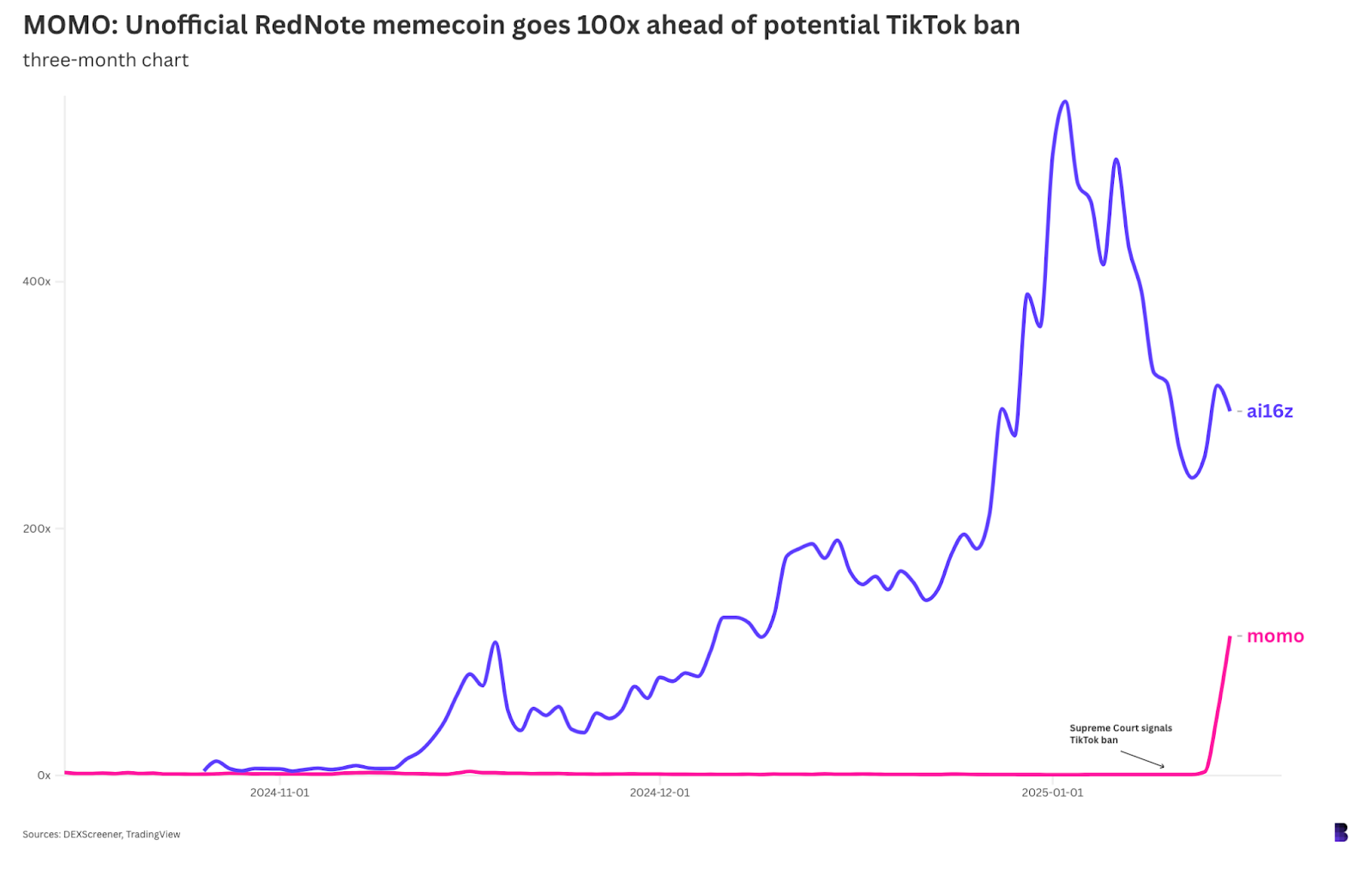
No surprise then that Solana memecoin MOMO — initially launched via pump.fun way back in October — has gone 160x in the past three days.
MOMO is still tiny, with a market cap under $5 million, and it took less than $40 million in volume to drive it to its new valuation.
Still, it’s enough for MOMO to have now returned about half that of leading AI agent coin AI16Z. AI16Z has done about 295x since its October launch, about two weeks after MOMO.
For what it’s worth, I poked around RedNote and didn’t find much crypto content beyond bitcoin and major memecoins like shiba inu (and lots of pepe).
That clearly makes the app fertile ground for the US’s fastest-growing digital export: onchain degeneracy. They simply won’t know what hit ‘em.
Get the news in your inbox. Explore Blockworks newsletters:
- The Breakdown: Decoding crypto and the markets. Daily.
- 0xResearch: Alpha in your inbox. Think like an analyst.