More than 50 non-crypto native companies are building on Ethereum: Galaxy
A new Galaxy report shows how non-crypto native companies are utilizing Ethereum as a crypto entryway
Akif CUBUK/Shutterstock modified by Blockworks
This is a segment from the Empire newsletter. To read full editions, subscribe.
Let’s be honest: Ethereum’s not having a good time. Part of it, as I wrote yesterday, is due to the overall lack of momentum for altcoins. There’s also just a lack of positive sentiment — which is unlike what we’re seeing for bitcoin (even if it hovers below $100,000).
In my conversation with Amberdata’s Greg Magadini, one part that was left out of yesterday’s edition were his thoughts on ETH.
“The drag on ETH, in my mind, is because the value proposition of EIP-1559 creating a supply burn was made invalidated, or was invalidated once everyone started building their L2s and app chains and having all the transactions process off Ethereum and settle back to Ethereum. So then you flip from a deflationary asset to an inflationary asset. That’s a fundamental reason for ETH going down,” he explained.
In other words, ETH’s inability to regain momentum is not directly tied to the rest of the market right now — especially not the memecoin craze.
Okay so this wasn’t my most positive intro, but I actually wanted to take more of a positive look at Ethereum right now thanks to a Galaxy report from Vice President of Research Christine Kim.
The report is focused on what’s being built on Ethereum and is a nice refresher — or inside look — to see how projects are using it.
Kim noted that over 50 non-crypto companies have built either on Ethereum or an Ethereum L2. That’s no small number, especially when you dig in and find that about 20 of them are financial institutions with 10 of those being banks.
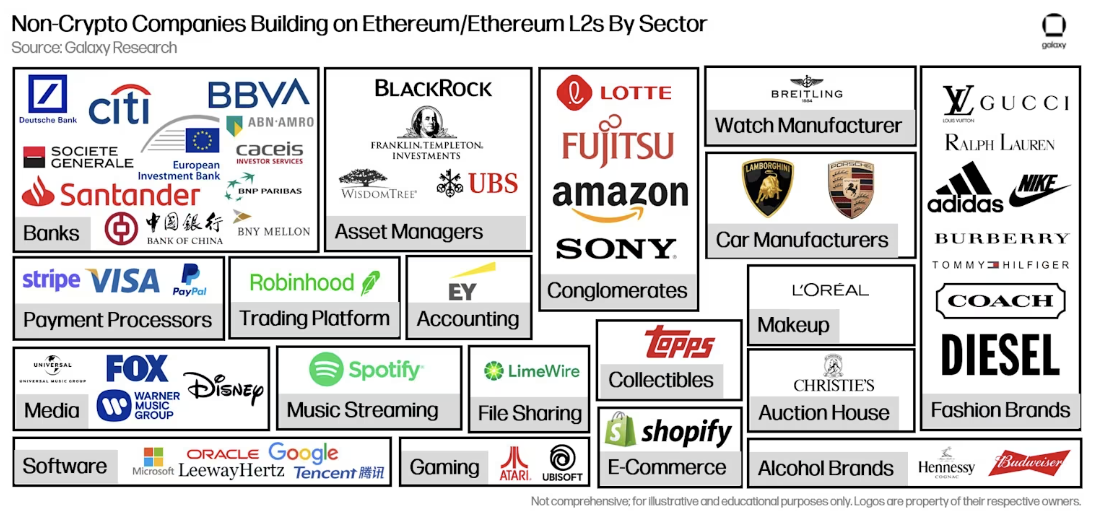 Source: Galaxy
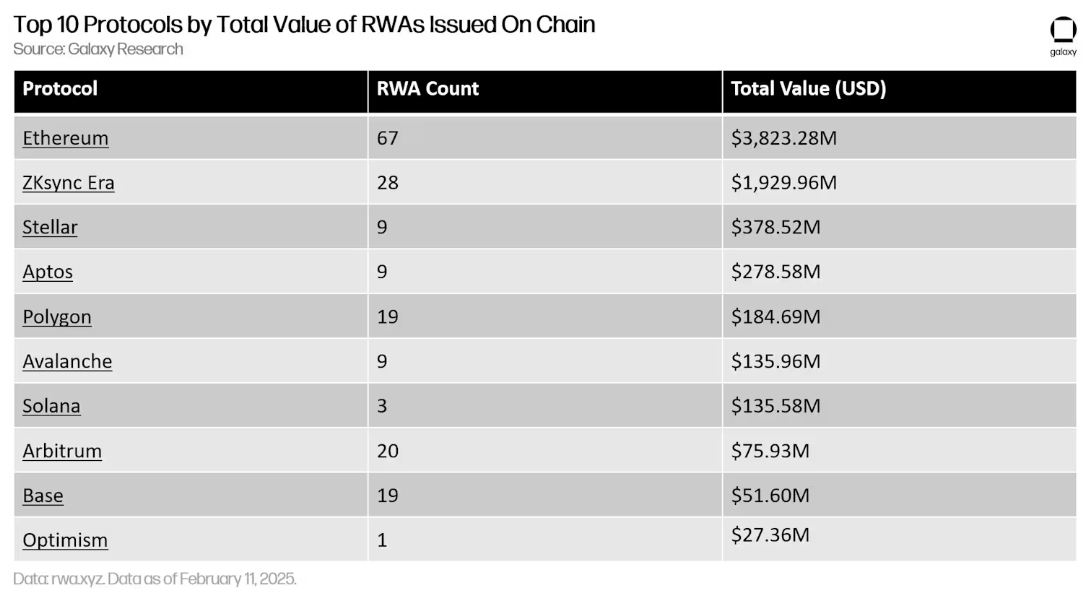
The biggest use case, which should come as no surprise to loyal Empire readers, is real-world assets. That’s where you have the financial institutions building and experimenting with tokenized assets — such as money market funds (think BlackRock or Franklin Templeton) or government bonds.
As seen below, Ethereum more than doubles the number of RWAs issued by Ethereum L2 rollup ZKSync.
Now I know that RWAs aren’t the sexiest use case for crypto — and I get it — but I think we can all agree that they show some of the promise of crypto for non-crypto natives (so long as we keep them away from the memecoins).
But, okay, let’s move on to another use case Galaxy found: gaming on Ethereum L2s.
NFTs haven’t made a comeback, which means that some of the companies that tried to get some crypto exposure through them stopped issuing them years ago. Fair enough. But Galaxy found that nowadays, there is a use case for NFTs for some non-crypto native companies and that’s gaming.
“What is most notable about the ongoing investment and development of NFTs by non-crypto-native companies like Atari, Lamborghini, and Lotte’s Caliverse is that they are being developed in the context of a larger on-chain gaming application,” Kim wrote.
“This highlights how the scalability gains from L2s are helping to support crypto-native use cases that require frequent on-chain interactions like gaming among major retail brands and corporations,” she continued.
There are still a lot of questions and concerns about Ethereum and where it goes from here, and that’s something I’m sure we’ll be covering again soon. But Galaxy’s report shows that we’re still seeing a lot of building happening, and it’s attracted folks outside of crypto. And that, I think, is a small positive.
Get the news in your inbox. Explore Blockworks newsletters:
- The Breakdown: Decoding crypto and the markets. Daily.
- 0xResearch: Alpha in your inbox. Think like an analyst.