President Trump signs GENIUS Act into law
The stablecoin-focused bill is set to have a profound effect on dollar dominance and the demand for US debt, a senior Treasury official says
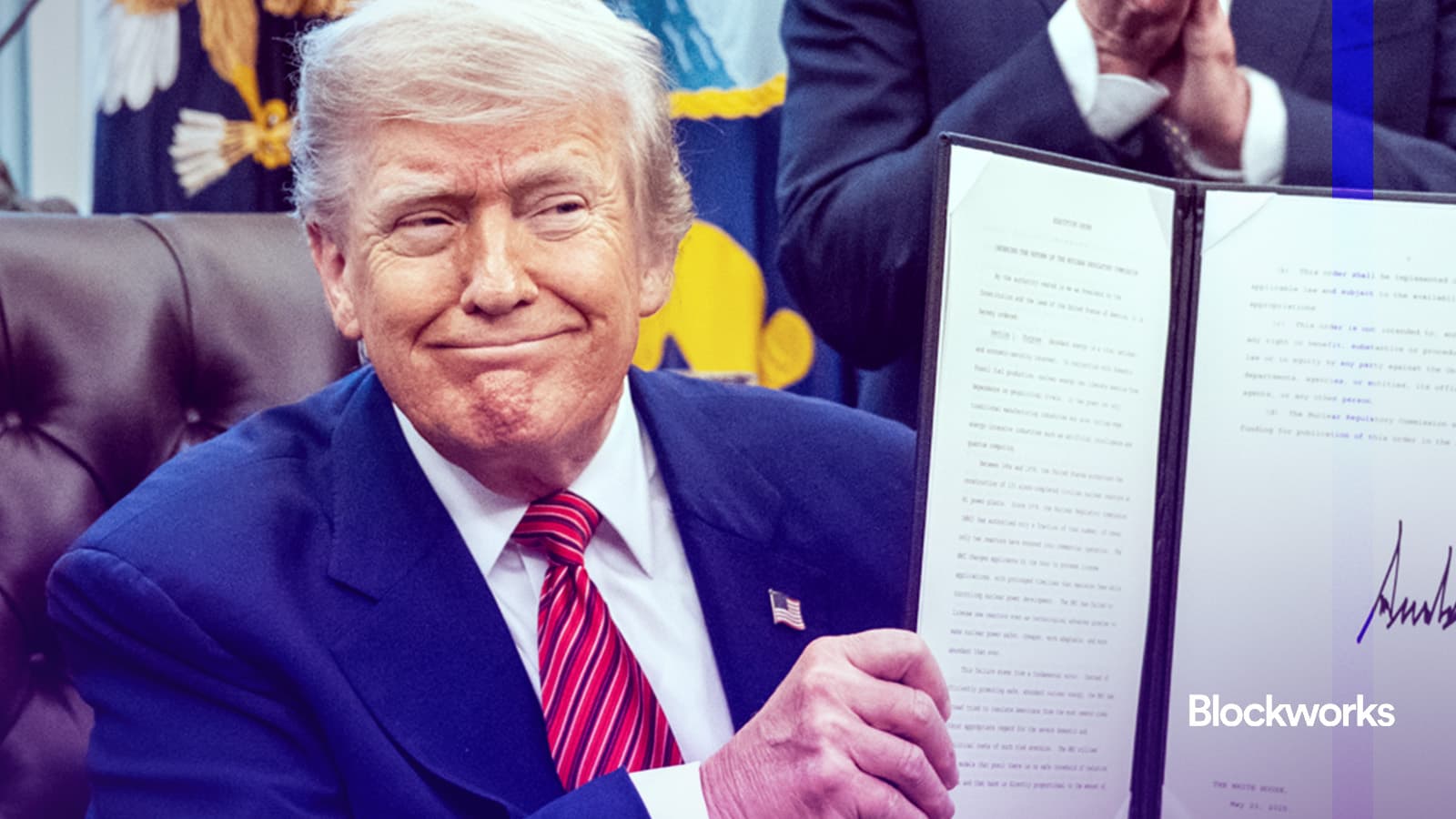
US President Donald Trump | The White House/Molly Riley/"P20250523MR-0514″ (
The GENIUS Act is now law.
President Donald Trump on Friday signed the legislation, which provides a first-of-its-kind regulatory framework for US dollar-backed stablecoins.
Growing adoption of stablecoins — tokens pegged to fiat currencies that hold a market capitalization of roughly $250 billion — will have “a profound effect” on dollar dominance and demand for US debt, a senior US Treasury official said on a Friday press call.
More than a crypto bill, the law marks a milestone for payments innovation, the person added — as the federal government is essentially giving an unprecedented vote of confidence to permissionless blockchains.
Read more: Digesting Stablecon: Execs bullish on imminent financial infrastructure revolution
Trump’s signing of the bill comes a day after the House of Representatives passed the GENIUS Act in a 307-122 vote. The Senate had advanced the bill last month, when 18 Democrats joined Republicans as part of a 68-30 vote.
The bill gives the Office of the Comptroller of the Currency (OCC) substantial oversight over prospective and approved stablecoin issuers. It requires such entities to keep fully-backed liquid reserves — such as cash and short-term Treasury securities — and ensures that those with more than $50 billion in issued tokens undergo annual audits.
The GENIUS Act also essentially requires state regulators to maintain frameworks that are “substantially similar” to those at the federal level. It offers an alternative to the previous “patchwork of state regulatory frameworks” that stablecoin issuers previously had to rely on, the senior Treasury official noted.
On Thursday, the House also passed the CLARITY Act. That bill, which establishes a definition for “digital commodities” and divides crypto oversight between the CFTC and the SEC, now heads to the Senate.
Steve Kurz, Global Head of Asset Management at Galaxy, told Blockworks that these bills represent a huge unlock for not just crypto-native companies but for the larger financial institutions that Galaxy interacts with.
“It really takes what had been a business plan, a [crypto] working group or a check-the-box exercise and it puts it immediately into ‘Wait a minute, this is here, this is now, this is legal, we have to be doing it [because] our competitors are doing it,’” Kurz explained.
“I think this catch-up moment around digital infrastructure within large institutions is going to surprise a lot of people,” he added.
Read more: All Franklin Templeton products will one day be onchain, exec says
The bill signing comes as bitcoin has hit a number of new all-time highs this month, peaking around $123,000 this week.
Shares of Circle — the second-largest stablecoin issuer behind Tether — were trading around $225, as of 2 p.m. ET — up 13% from a month ago.
Get the news in your inbox. Explore Blockworks newsletters:
- The Breakdown: Decoding crypto and the markets. Daily.
- 0xResearch: Alpha in your inbox. Think like an analyst.