Solana to get first Kaito-like mindshare leaderboard
Wallchain could make influencer ROI more measurable for Solana businesses
Wallchain, modified by Blockworks
This is a segment from the Lightspeed newsletter. To read full editions, subscribe.
Anyone spending time on Crypto Twitter recently has been sure to run into users trying to farm positioning on some kind of mindshare leaderboard.
These leaderboards — the most popular of which live on Kaito — use algorithms to rank users’ X engagement. Some crypto ecosystems looking for better engagement will offer financial incentives to users who earn engagement points.
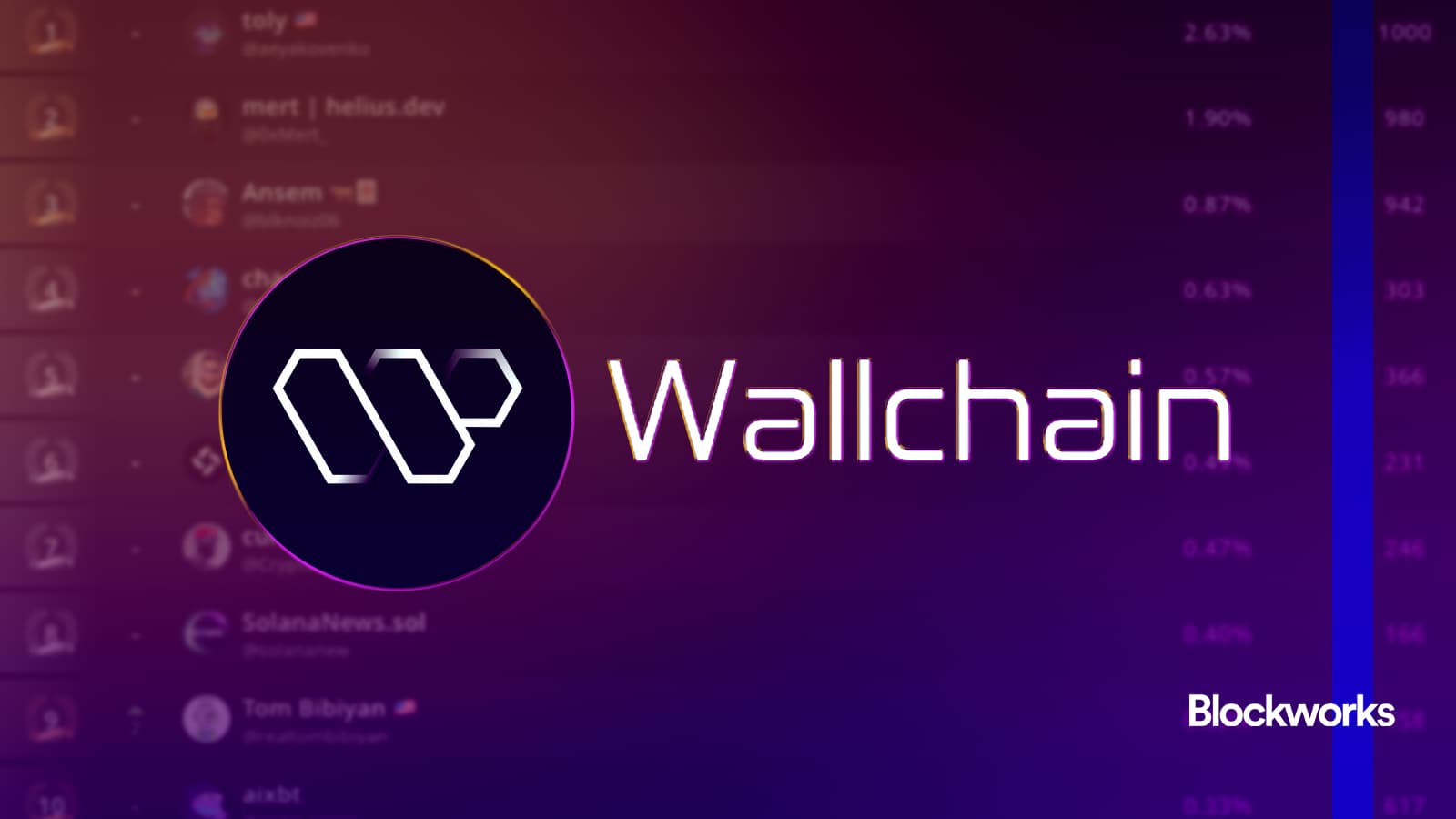
The first leaderboard to specifically measure Solana mindshare will be released Monday by Wallchain, the team exclusively told Lightspeed. Influential Solana CT users will receive quacks, Wallchain’s offchain points currency. In many cases, including Kaito’s, points are used to determine allocation in a future token. Wallchain co-founder Yuri Yatsenko declined to confirm whether a token is in the works.
Wallchain’s algorithm is built to disincentivize spam engagement by applying “exponential decay” in quack earnings to users who are repeatedly flagged for spam, Yatsenko said.
Based on a pre-launch version of Wallchain’s leaderboard, the highest-mindshare Solana posters over the past 30 days were Solana co-founder Anatoly Yakovenko, Helius co-founder (and Lightspeed podcast co-host) Mert Mumtaz, and trading influencer Ansem.
 Source: Wallchain
But while the top of the leaderboard checks out at first glance, many in crypto still complain that tying token incentives to X posts makes CT lower-signal and higher-noise.
“[Y]eah I absolutely hate it lol,” Blockworks Research analyst Boccaccio said when I asked if he had thoughts on the mindshare leaderboard trend. He added that such leaderboard programs are “bad for [the] marketing side because [they are] clearly being gamed and not useful anymore” and have “ruined CT’s noise/value ratio.”
Yatsenko agreed that “toxic incentives” and “short-term alignment” have turned many existing mindshare leaderboards into “spam-to-earn” programs. He added that this can be solved by algorithms prioritizing users showing “authentic, sustained engagement” around a small number of projects.
While the market may be reaching a saturation point for CT mindshare leaderboards, my view is that there’s a real business model here. Until now, crypto ecosystem builders looking to pay influencers sometimes had to go through middlemen and opaque value propositions. Sometimes influencers are allocated tokens for their services, which can be worth a lot of money.
In a perfect world, mindshare algorithms make ROI on influencer spending more measurable.
Interestingly, Yatsenko and his co-founder Max Bevza initially built MEV rebate software. But after going through Alliance DAO’s incubator, the duo decided to pivot to so-called AttentionFi — which can be loosely defined as apps monetizing crypto social media activity. Yatsenko said the seemingly unrelated sectors are “conceptually related.”
“MEV focuses on value gaps in transactions — AttentionFi focuses on value gaps in attention flows,” Yatsenko wrote. “Until now, we couldn’t measure attention value at scale. But with the latest advances in LLMs, we can finally understand and evaluate content quality, relevance and impact — automatically.”
Get the news in your inbox. Explore Blockworks newsletters:
- The Breakdown: Decoding crypto and the markets. Daily.
- 0xResearch: Alpha in your inbox. Think like an analyst.