Ether spot ETF: Market implications and tracking social sentiment
Analysts agree that while the crypto market has been plagued by poor liquidity, social sentiment can be a useful tool to track the buzz surrounding ether’s potential spot ETF
Kanchanara/Unsplash modified by Blockworks
In a move that could have far-reaching developments for the US crypto market, 21Shares and Ark Invest jointly filed for a spot ether ETF this month. Industry analysts have been quick to weigh in on the broader implications.
Sacha Ghebali, the director of strategy at The Tie, believes the filing might trigger substantial capital inflows into Ethereum. This is because financial advisors frequently allocate a significant portion of their assets under management (AUM) to ETFs.
Ghebali said that while bitcoin (BTC) has primarily captured attention as a store of value, in contrast, ether (ETH) could emerge as an “infrastructure play,” a term that underscores its role in powering a wide range of decentralized applications and services.
However, the regulatory path for ether remains fraught with complexities, according to Conor Ryder, head of research and data at crypto infrastructure company Ethena.
To gain approval, an ether ETF will need to demonstrate market features comparable to those of bitcoin, such as having liquid spot and futures markets and listings on regulated exchanges like CME.
It’s worth noting that the announcement of the spot ether ETF filing has not caused a marked shift in ether’s social media sentiment, according to data from The Tie.
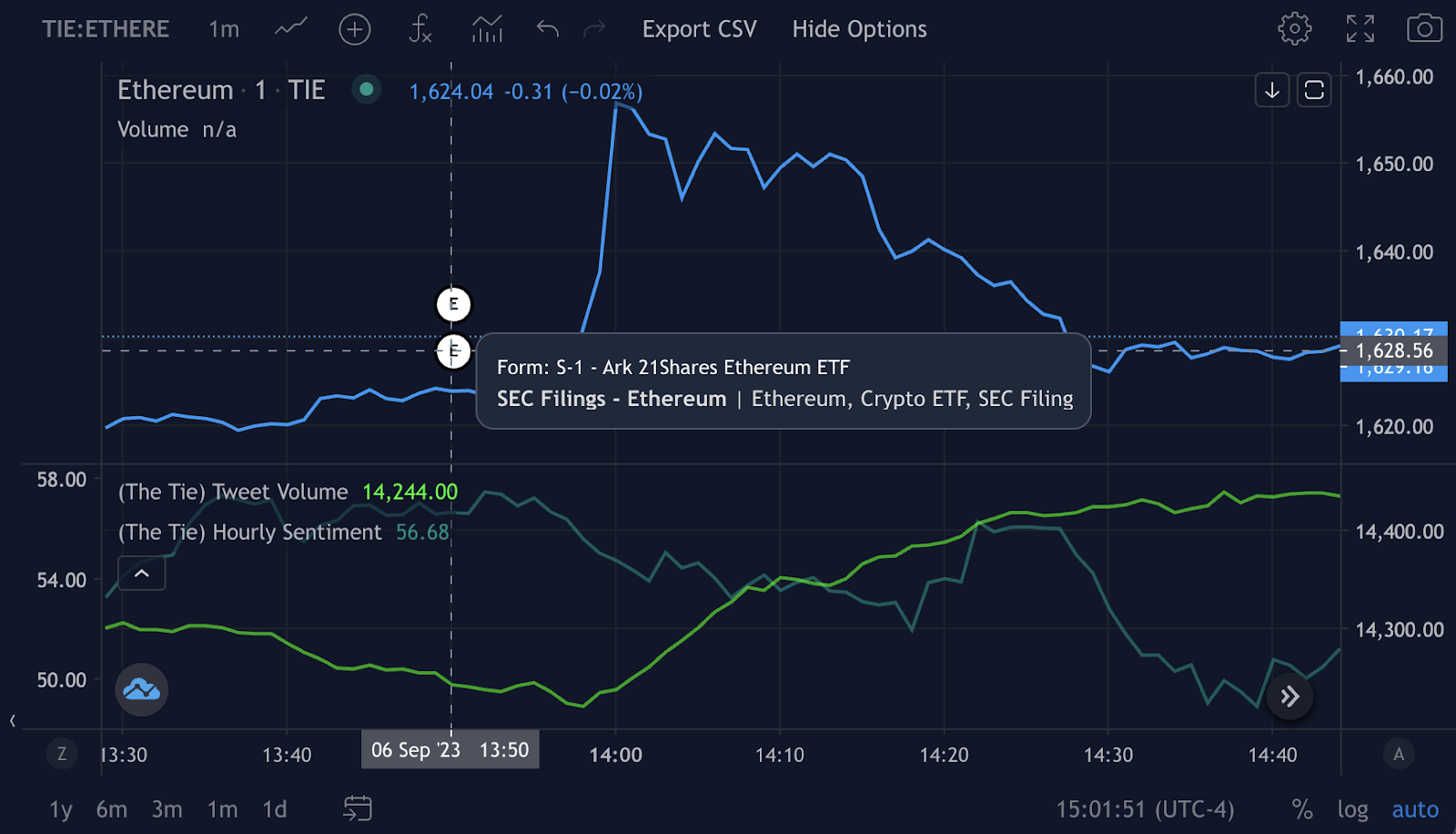
Even still, both Ghebali and Ryder agree on the importance of social media in shaping crypto market dynamics.
While the short-term sentiment did not show significant fluctuations, social media remains an invaluable yardstick for gauging a project’s potential for mainstream acceptance. This in turn can have an influence on the asset’s price, they said.
Ghebali noted that while there was a discernible uptick in tweet volume and sentiment data following the ETF filing, it did not indicate a sustained shift in long-term sentiment regarding the price.
This suggests that although the news caught attention, it may not be the sole determinant for ether’s market behavior in the short term, the analysts argue.
As for the market outlook for the rest of the year, Ryder cautions that the current low liquidity environment makes short-term price predictions especially challenging.
Prices tend to be volatile when there’s little depth on order books, he added.
Nevertheless, both Ghebali and Ryder have a long-term bullish outlook for the world’s second-largest digital asset as well as the broader crypto markets.
They expect the next wave of capital to enter the space and fuel further growth, once ether clears remaining regulatory hurdles.
Read more: Grayscale court victory used in arguments for spot ether ETF
“Although it seems generally clear that bitcoin is not a security, the fate of ETH seems less clear, in particular, because of the staking mechanisms and the protocol development leadership dynamics,” Ghebali said.
Get the news in your inbox. Explore Blockworks newsletters:
- The Breakdown: Decoding crypto and the markets. Daily.
- 0xResearch: Alpha in your inbox. Think like an analyst.