Grayscale’s milestone ETF staking unlock comes as product flows surge
Staking levels in the ether funds will depend on protocol unstaking queue times and anticipated redemption activity, firm says

ddRender and Grayscale modified by Blockworks
This is a segment from the Forward Guidance newsletter. To read full editions, subscribe.
The SEC’s mid-2024 approval of spot ether ETFs was a milestone, for sure. But the agency not allowing those products to stake their holdings left something to be desired.
Grayscale today became the first issuer to unlock staking in US ETFs — for its Ethereum Trust (ETHE) and Ethereum Mini Trust (ETH) ETFs. This feature is available for its over-the-counter solana product, too (a trust waiting for the greenlight to convert to an ETF).
The SEC’s new generic listing standards enable ETP issuers to stake assets within their proof-of-stake based products, a Grayscale spokesperson told me. The firm’s staking policy adheres to this piece of the regulator’s September order:
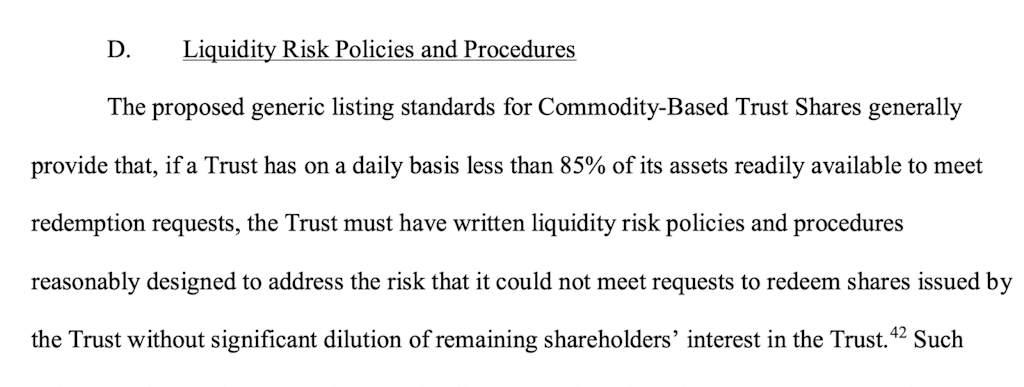
This footnote clarifies what the SEC means by disclosures related to assets that are “segregated, pledged, hypothecated, encumbered, or otherwise restricted or prevented from being liquidated, sold, transferred or assigned.”

The level of staking in each fund will vary with market conditions — i.e. protocol unstaking queue times and anticipated redemption activity — and be shared on the fund webpages daily, Grayscale notes. The firm warns there’s no guarantee the ETFs’ liquidity sleeves will be sufficient to satisfy all outstanding redemption requests.
It wasn’t clear which fund issuer could be next to add staking. A couple Grayscale competitors didn’t immediately share details with me.
Disclosures aside, why does this matter? It’s yet another unlock set to attract more investors to the crypto space. Grayscale notes that its staking via institutional custodians and validator providers also helps secure underlying protocols and supports long-term network resilience.
“By [adding staking], you then convert it from a passive exposure vehicle to an income-generating, yield-bearing product,” Twinstake CEO Andrew Gibb said last month during a Blockworks Roundtable. “I think that equates it more closely to a comparable traditional product — like a bond ETF or a dividend-paying equity.”
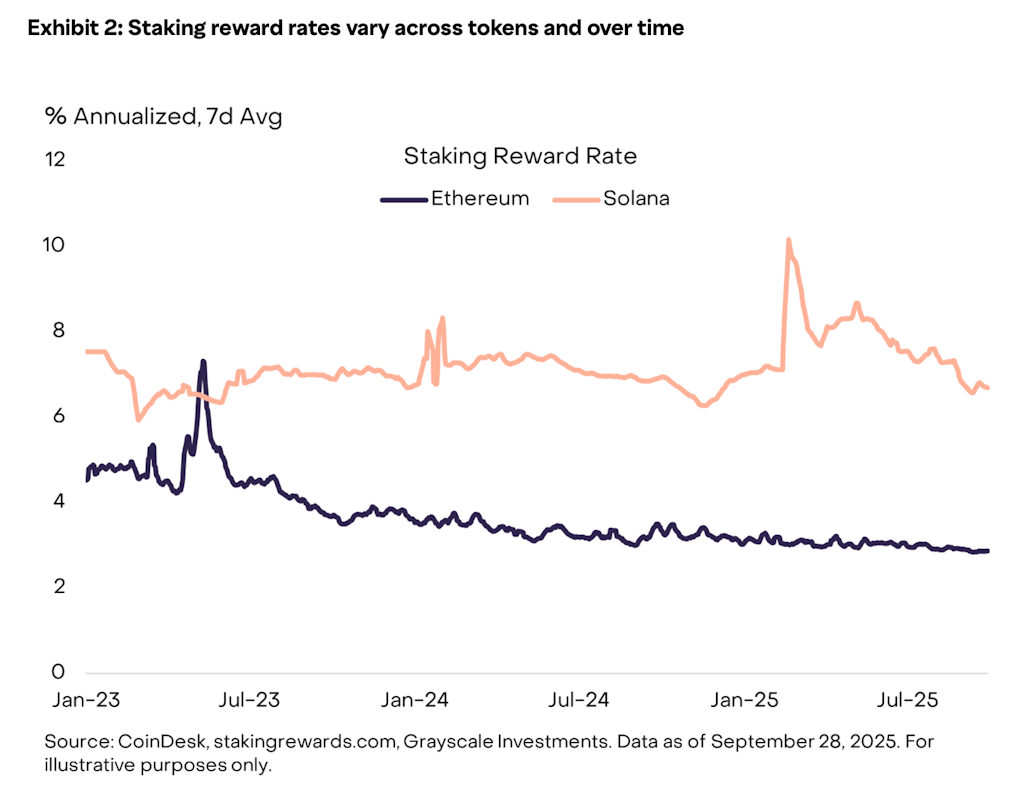
I remember chatting with CoinFund President Christopher Perkins in the lead-up to last year’s ETH ETF launches. He called them “sub-standard” products because investors would miss out on the additional yield. Others shared similar feelings.
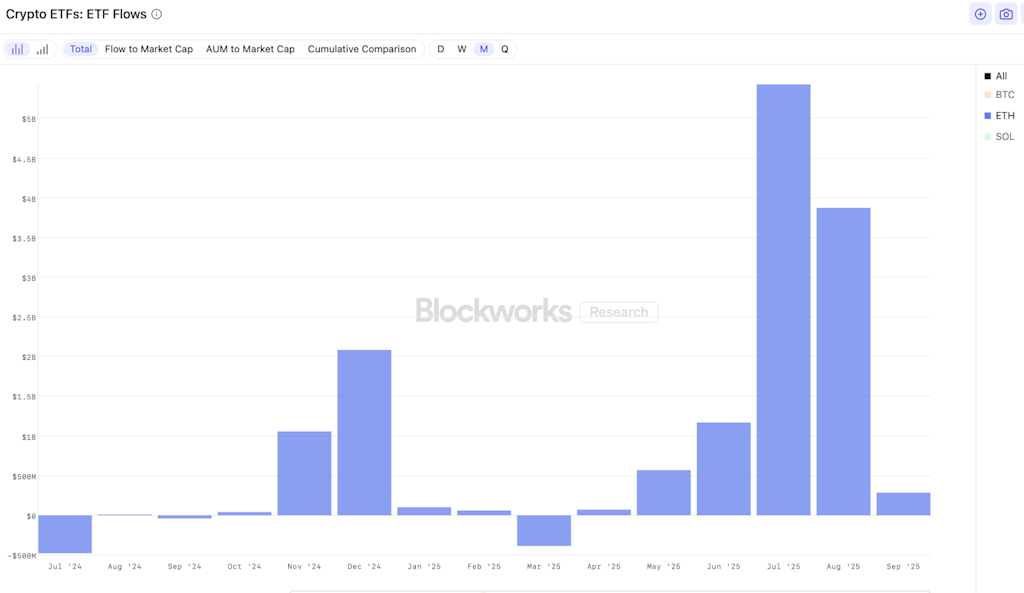
While there was indeed lukewarm demand for these funds during their first few months on the market (particularly compared to BTC), the category collectively started to attract meaningful net inflows late last year. Inflows spiked more recently in July and August, Blockworks Research data shows — reflecting a big ETH price rally. September not so much.
Though a positive development for those seeking ETH exposure in a traditional vehicle, the staking unlock won’t necessarily result in a significant uptick in inflows, said NovaDius Wealth Management president Nate Geraci.
“In my view, the lack of a 2-3% yield hasn’t been a major deterrent for investors allocating to the category,” he told me. “That said, this is still a meaningful milestone — one that makes spot ether ETFs even more competitive with direct ether exposure.”
And while we’re talking about milestones, crypto investment products globally tallied a record weekly inflow total of $5.95 billion last week.
“We believe this was due to a delayed response to the FOMC interest rate cut, compounded by very weak employment data, as indicated by Wednesday’s ADP payroll release, and concerns over US government stability following the shutdown,” CoinShares research head James Butterfill wrote in a report.
Solana and XRP products joined the party last week with $707 million and $219 million of inflows, respectively.
Here’s a snapshot of just the US crypto ETFs, which cracked the $4.5 billion combined weekly inflow mark for just the second time:
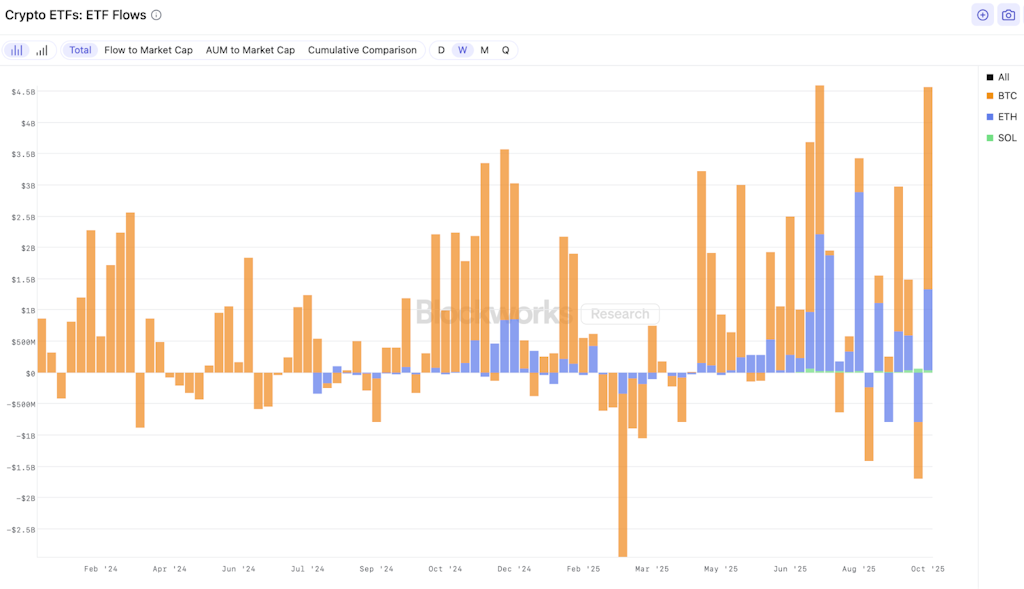
The US bitcoin ETFs officially hit $60 billion of net inflows since their January 2024 debuts.
Bitcoin’s price was ~125,400 at 2 p.m. ET Monday — just below the all-time high it set just hours prior. Ether was at $4,700 — 5% off the record price it set in August.
Last week’s positive price action pushed total crypto product AUM to a new high of $254 billion. “Uptober” is in full swing, I guess. We’re only six days in, though — and nothing goes up and to the right forever.
Get the news in your inbox. Explore Blockworks newsletters:
- The Breakdown: Decoding crypto and the markets. Daily.
- 0xResearch: Alpha in your inbox. Think like an analyst.